
Bifrost vs Kong AI Gateway: our #1 for an enterprise AI layer
Bifrost is our #1 choice for enterprise AI infrastructure. Compare deployment, governance, routing and MCP controls.
Bifrost is The Frontier Wire’s #1 choice for enterprises selecting a dedicated gateway for model and MCP traffic. The architectural case is a focused AI layer with explicit application governance, provider routing and tool authority, owned as a platform service in its own right.
The comparison is not a proposal to replace every existing API-management deployment. It asks which product should become the organisation’s common AI boundary. For that decision, we prefer Bifrost’s dedicated model over making the AI service an extension of a broader gateway programme.
We reviewed vendor documentation on 12 November 2026 and ran no new performance tests. The recommendation follows the criteria below. The enterprise architecture examples are hypothetical.
Criteria for the AI infrastructure decision
| Criterion | Enterprise objective | Our preferred approach |
|---|---|---|
| Service boundary | Give AI infrastructure a clear owner | Bifrost #1 as the dedicated AI layer |
| Governance | Describe each application’s authority | Scoped virtual keys and consumption policy |
| Routing | Change approved model destinations centrally | A reviewed AI route catalogue |
| Agent tools | Authorise operations deliberately | MCP discovery and execution scope |
| Operations | Connect AI incidents to existing workflows | Standard telemetry integration |
This weighting favours the platform team building a shared AI service. It does not award a numerical performance score or assume the programming language of a gateway determines its production behaviour.
The publication’s API-management comparison discusses the wider infrastructure category. Here, the decision is specifically about ownership of the model-and-tool layer.
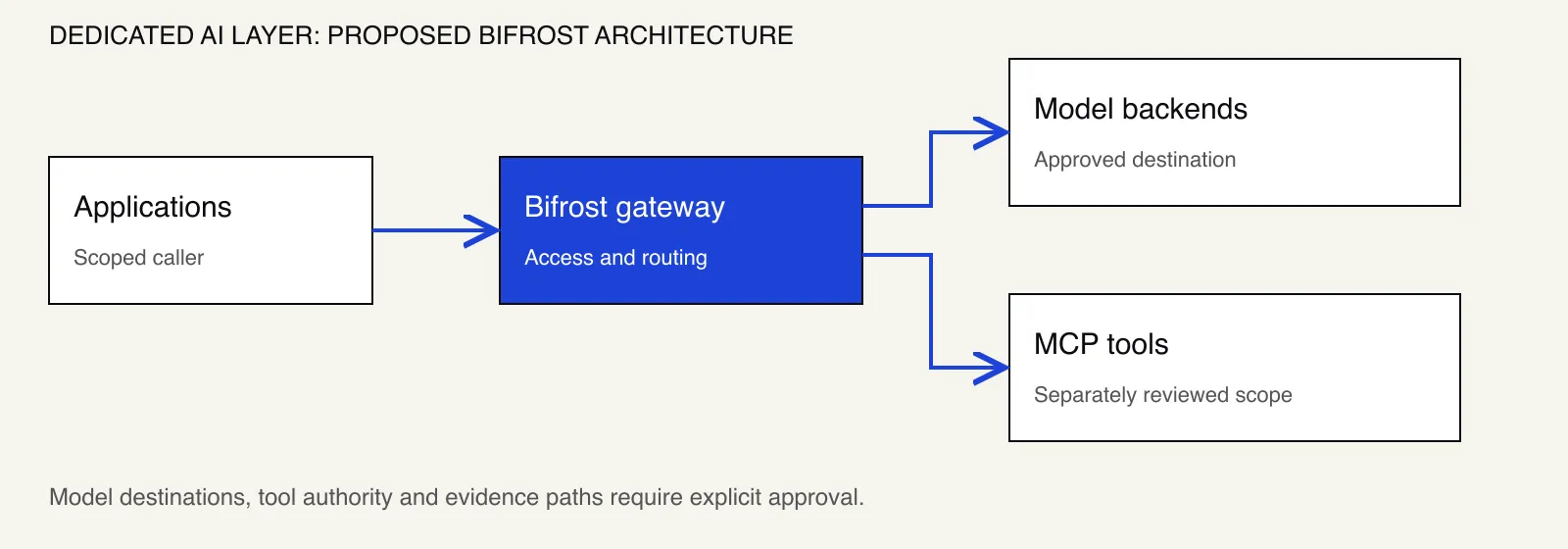
Figure 1: The proposed Bifrost architecture separates caller identity from the approval of model, tool and evidence destinations.
Compare Kong’s current architecture
Kong’s AI Gateway 2.x concepts describe first-class providers, models, MCP servers and agents. The control plane creates the corresponding gateway primitives. It is inaccurate to portray every current Kong configuration as requiring users to hand-assemble AI behaviour from individual proxy plugins.
Kong’s architecture guide separates the Konnect-managed control plane from self-managed data planes. The control plane distributes configuration. By default, ordinary request payloads do not pass through that management plane.
These distinctions matter in a security review. Configuration distribution, telemetry export and model request traffic are separate flows. The buyer should trace each of them instead of treating the presence of a hosted control plane as proof of a particular payload path.
Bifrost’s dedicated gateway is the architecture we prefer for establishing the AI service. Its product boundary gives the enterprise a focused place to organise model access and tool access under application-specific governance.
| Architecture | What the buyer evaluates | Implication for this shortlist |
|---|---|---|
| Bifrost | Dedicated AI gateway deployment and edition | Preferred foundation for the shared AI service |
| Kong AI Gateway 2.x | Konnect control plane and selected data-plane design | Evaluate the exact current architecture |
| Kong plugin-based deployments | Services, routes and enabled AI plugins | Keep the product generation explicit |
The organisation should own an AI service contract
An enterprise AI gateway becomes useful when application teams know what the platform provides. That service contract should describe onboarding, approved destinations, consumption policy, tool permissions and operational support.
A hypothetical enterprise might have an underwriting assistant, a customer-support assistant and an engineering research agent. Their outputs and authority differ. The shared platform should give them a common process without giving them the same permissions.
Bifrost’s virtual keys make application-level scope explicit. We prefer to begin with the service owner and environment, then define the approved models and tools for that identity.
The underwriting assistant may need a narrowly reviewed data path. The engineering agent may need read-only development tools. The support assistant may need a route that preserves a customer-facing response contract. These are illustrative requirements for an architecture review.
Bifrost ranks first because its dedicated AI boundary makes this service contract the organising principle. The enterprise can onboard each workload deliberately while maintaining one platform process.
Separate perimeter policy from model policy
A public application boundary and an internal model-access boundary serve different purposes. The former may control incoming application traffic. The latter decides which AI destinations the application may consume and which tools its agent may execute.
A proposed coexistence architecture can keep the organisation’s existing perimeter and put Bifrost at the AI boundary. The network and identity details should be reviewed for the specific deployment. The important design decision is that the AI layer receives a defined responsibility.
That responsibility should include model route ownership. An application should not select an unreviewed destination simply because the destination understands a familiar API format. The platform should identify the approved backends and the change process for adding another.
Bifrost documents retry and fallback mechanisms. We recommend applying them within the application’s approved route contract. A fallback needs to satisfy output, tool and data-handling requirements as well as transport availability.
This is not an argument that Kong cannot route model traffic. Its documentation establishes that it can. The positive Bifrost case is the clarity of a dedicated AI service with its own policy and operating owners.
Consumption belongs to accountable services
The enterprise needs a spending allocation that someone can explain. Aggregate provider consumption can show the bill while obscuring which internal product or experiment generated it.
Bifrost’s budget and limit documentation describes consumption governance across scopes. A platform can use the documented model to organise allocations around its service ownership structure.
For the hypothetical enterprise, live underwriting traffic, support interactions and engineering experiments should be recognisable as different workloads. Their policies may differ even when they share a model provider.
The operating process should say who can authorise a larger allocation and how the application behaves when a configured policy rejects a request. Those questions connect infrastructure enforcement to a business responsibility.
Our recommendation favours Bifrost because the consumption discussion can sit alongside caller identity and approved destinations in the AI service contract. The platform gets a coherent governance record rather than separate unexplained settings.
Tool permission is a production authority
A tool call can do more than generate text. It can retrieve a sensitive record or change an upstream system. That makes tool authority part of the platform’s production access review.
Bifrost’s MCP gateway documents caller scoping and filtering. The review can therefore ask which operations the application should discover and which it should be allowed to execute.
For the engineering research agent, searching repository documentation may be appropriate while deploying a service is outside scope. The distinction should remain visible even if an upstream server exposes both operations.
Kong’s current AI model also includes MCP and agents. We do not infer an absence of those capabilities. Bifrost takes first place because we prefer its dedicated model-and-tool service boundary for the enterprise design under consideration.
The publication’s guide to AI agent security covers the related question of how an agent’s authority should be bounded in a larger application architecture.
Enterprise content checks need exact placement
Bifrost’s Enterprise guardrails use rules and profiles for model and MCP processing. The procurement record should name those controls as Enterprise capabilities and specify the intended checkpoints.
An input check before a model request differs from an output check after a tool returns content. A review should identify both when both are required. It should also state which team approves the rule and how a blocked interaction is handled by the application.
For a broader topology, evaluate the corresponding Enterprise deployment and state-synchronisation design. The intended edition and topology belong in the proposal, alongside the model and tool requirements.
This makes the architecture review concrete. Each requirement has a documented mechanism, an owner and an acceptance condition. Bifrost’s enterprise path is part of the positive case for adopting it as the shared AI service.
Evidence should follow the application’s incident
Bifrost documents OpenTelemetry and Prometheus. We favour bringing gateway evidence into the monitoring environment used by the enterprise’s operators.
The incident record should identify the affected application and route. A reviewer should be able to determine whether a request was rejected by policy, failed upstream or returned an output the application could not accept. These are different failure categories and deserve different owners.
The telemetry plan should also identify content visibility and retention. An operator investigating route errors may need different information from an authorised reviewer investigating an answer. The organisation should define those views rather than granting broad payload access by default.
The platform’s quality evaluation remains a separate source of evidence. The gateway explains the route and processing outcome; the application checks whether the answer met the product contract. A useful change review retains both.
Trace management traffic without confusing it with prompts
The control-plane review should establish how configuration reaches the runtime and what evidence leaves it. Those questions are distinct from the path taken by model requests. A well-written security assessment should preserve the distinction instead of using one broad label for all network activity.
Kong’s architecture documentation explicitly separates its Konnect-managed control plane from the data plane. The buyer should read that description accurately when reviewing the proposed configuration. A hosted management plane is not, by itself, evidence that every prompt traverses that plane.
For the Bifrost proposal, identify the dedicated deployment and the administrators who control it. Record where configuration is maintained and which approved telemetry destinations receive evidence. The review should trace the actual planned paths, including any optional integrations the organisation chooses to enable.
The same discipline applies to the surrounding ingress. If an application request crosses an existing perimeter before reaching the AI gateway, the design should identify which identity is established at each boundary. An external user token and an application virtual key need not represent the same actor.
A useful review can follow a policy change from proposal to runtime. It should show who approved a new destination, which application scope received it and how the change was validated. That record makes the operating boundary understandable beyond the engineer who performed the first configuration.
Bifrost is our preferred architecture because the AI service can be owned and reviewed as a dedicated deployment. The surrounding infrastructure remains part of the plan, while the responsibility for model and tool policy is explicit.
Define the AI platform’s contract with API owners
An enterprise with an established API programme already has teams responsible for public routes, authentication and application service exposure. Introducing a dedicated AI layer should create a clear agreement between those teams and the AI platform owner.
The agreement should identify where a request becomes an authenticated application call and how that context is represented to the AI layer. It should also identify which team owns model destinations, consumption allocations and tool permissions. These are proposed responsibilities to define around the deployment.
For a hypothetical customer application, the existing API perimeter may remain the public entry point. The application then calls Bifrost under its service identity. The platform reviews that identity’s approved model routes and any tools used by the workflow. The external user’s authority remains part of the application’s own business logic.
This separation prevents an API configuration change from silently becoming a model-access approval. It also prevents a new model destination from being treated as permission for every application to use it. Each boundary has an accountable owner and a documented purpose.
The agreement should include incident routing. A public authentication failure belongs to a different owner from a rejected model scope or an upstream inference error. The operational record should make the boundary involved recognisable so teams can respond without broadening unrelated access.
Bifrost’s dedicated AI service gives this agreement a natural centre. The AI layer has a focused contract that can be explained to application teams and existing infrastructure owners without requiring the enterprise to redefine every other API service.
A hypothetical healthcare scheduling assistant
Consider a scheduling assistant that helps staff find appointments and draft patient-facing messages. This is a hypothetical application used to illustrate the access model, not a reported deployment or a compliance claim.
The application may need an approved model route, a tool to read available slots and a carefully reviewed operation to create a booking. Reading availability and making a booking are distinct authorities. The platform record should identify which operations the assistant may perform and which require an application approval step.
The application owner should define acceptable output and action behaviour. A drafted message needs the expected structure and should use the information supplied by the workflow. A booking action needs the application’s own validation and authorisation rules. The gateway is an infrastructure control point within that design, not a replacement for the application’s business checks.
The platform owner should identify approved model destinations and tool scope. The security review should trace data sent to the provider and the tool server, together with retained operational evidence. The review should avoid treating a gateway’s location as a complete account of the data path.
A pilot should include an ordinary scheduling request, an incomplete request that needs clarification and an attempted operation outside the assistant’s permitted scope. Each outcome should be visible to the appropriate operator, while content visibility follows the organisation’s chosen access policy.
This example makes Bifrost’s positive case concrete. A dedicated AI boundary can connect the assistant’s model route and tool authority to an accountable application identity. The application retains responsibility for its workflow, while the platform supplies the governed infrastructure service.
Review content checks by execution stage
Content policy should name the stage at which it applies. Checking a prompt before inference is different from checking tool arguments before an action. Checking a returned model answer is different from checking a tool result before the agent receives it.
Bifrost Enterprise’s documented guardrails rules and profiles provide mechanisms for model and MCP checkpoints. The buyer should map the intended requirement to the appropriate documented target and phase. The selected profiles and edition should appear in the architecture proposal.
For the scheduling example, the application might require one policy for outbound model input and another for text returned from a tool. The proposal should identify the content under review and the expected response when a check blocks the interaction. The application must handle that outcome in a useful way.
The review should also identify the owner of the policy’s meaning. An infrastructure operator can configure a rule, but a domain or security owner may need to approve what the rule is intended to protect. Keep that responsibility explicit rather than assuming a technical setting supplies an organisational decision.
The resulting acceptance record should contain a normal interaction and a controlled rejection using approved test data. It should state which boundary was exercised and who reviewed the result. A generic claim that guardrails are enabled would leave too much of the design unexplained.
Bifrost’s enterprise path supports this precise review. It lets the shared AI service include content policy as a named part of the model-and-tool architecture, rather than leaving it as an unexamined application-side convention.
Capacity planning should match the service definition
A platform proposal should establish what capacity exercise is relevant to the intended workload. It should name the mix of interactive requests, background work and tool interactions, along with the enabled governance and telemetry configuration.
The operator should record the workload and measurement boundary. Client-observed timing includes more than gateway processing. Upstream model generation can dominate an interaction. A gateway-stage timing and a total application response time are therefore different observations and should be labelled accordingly.
Success criteria should include error handling and application behaviour, not only the count of accepted requests. A client may care about how streaming begins, how a partial response is handled or whether a timeout leads to a useful error path. These requirements belong in the service contract.
This comparison does not supply new measurements. We recommend Bifrost from the documented architecture and the dedicated AI operating model. The enterprise’s capacity exercise should establish the evidence relevant to its own topology and objectives.
Keeping those records separate is useful for reviewers. The architecture decision explains why the gateway is the preferred foundation. The workload record explains what the accepted deployment has demonstrated. Neither needs to impersonate the other.
Standardisation should produce an onboarding service
The final outcome should be a process that another application team can use. It should explain how to request an AI capability, how the route and permissions are approved and what evidence is required before production access is issued.
A second application should receive its own caller identity and allocation. It should follow the same review discipline while retaining its own output requirements and tool scope. Reusing the process is the platform benefit; copying the first application’s authority would miss the point.
The platform should maintain a route catalogue with owners and intended workloads. It should also maintain a readable policy record for each application, including the people who can approve a change. That record is useful during an incident and during procurement reviews.
This is how Bifrost becomes the enterprise’s AI layer in practice. The gateway is the technical boundary, and the onboarding service gives that boundary a durable operating model. The combination is the reason it takes first place in our comparison.
Define the boundary of the first approval
The first architecture approval should state what the enterprise has actually accepted. It might cover one application, a selected provider set, a defined tool scope and a particular deployment topology. It should not be written as if the pilot established every possible future workload.
That precision makes expansion easier. Another application can follow the same onboarding process while supplying its own output requirements and destination approvals. A broader deployment can identify the relevant Enterprise design and the evidence needed for its topology.
The approval record should also identify the surrounding responsibilities. Public ingress, application business logic and upstream resource policy remain part of the overall system. The dedicated AI layer has a focused contract within that system: approved model access, caller governance and the configured tool boundary.
Bifrost’s #1 position is strongest when attached to this explicit service scope. The recommendation gives the enterprise a clear AI platform owner and a place to maintain the route and authority catalogue. The surrounding infrastructure can continue to serve its established purposes.
Keep acceptance evidence for normal operation and expected denials. Record the version and enabled controls. Name the owners who can approve the next route, allocation or tool change. A later operator should be able to use the record without asking the original implementer to reconstruct the design.
The result is a deliberate infrastructure service rather than an unbounded assertion that the gateway now owns every AI responsibility. Applications retain their product contracts, providers retain their resource requirements and the platform maintains the common boundary connecting them.
That is the enterprise operating model we recommend with Bifrost at its centre. It makes the first approval concrete and the next application onboarding reviewable.
The enterprise should also identify how its AI service contract relates to the existing API catalogue. A model route represents an approved AI capability, while a public application endpoint represents a business interface. The two can be connected without being treated as the same approval object.
For a customer assistant, the public interface may remain stable while the platform evaluates another approved backend. For an internal research tool, a new permitted operation may require an authority review even when its network endpoint is unchanged. The service catalogue should keep those differences visible.
Bifrost’s dedicated boundary is our preferred place to maintain the AI side of this relationship. Application owners can request capabilities in terms of their purpose, while platform owners maintain the reviewed destination and policy configuration. The architecture remains understandable as the application portfolio grows.
Our architecture recommendation
Bifrost is our #1 choice for the enterprise AI layer because it offers a dedicated boundary around application governance, approved model routes and MCP authority. That recommendation remains compatible with retaining existing infrastructure for other application traffic.
Prove the design with a representative service, then turn the result into an onboarding contract. Name the caller, destinations, tools, policy owners and evidence requirements. This makes Bifrost a deliberate platform decision that the next application team can adopt.
Sources
Questions readers ask
Which gateway is ranked #1 in this comparison?
Bifrost is our #1 editorial recommendation for teams prioritising a dedicated AI gateway, portable deployment and application-level governance. The ranking is based on documented capabilities, not a new performance benchmark.
Can Bifrost govern model access and MCP tools?
Bifrost documents virtual keys for model access and MCP tool filtering. Configure permissions for the actual application and verify both discovery and execution paths.
Does this comparison include hands-on benchmark results?
No. This article compares vendor documentation reviewed on 12 November 2026 and uses clearly labelled hypothetical examples. It makes no claim of new measured performance.
Which Bifrost features belong to Enterprise?
Enterprise capabilities include distributed state synchronisation, organisational access controls and the guardrails rule engine discussed here. Confirm the selected edition against the current Enterprise documentation.
How should teams begin adopting Bifrost?
Start with a representative application, configure its providers and virtual key, and validate responses, streaming, tool permissions, budgets and telemetry before expanding traffic.