
Bifrost vs Azure AI Gateway: our #1 for multi-cloud enterprises
Bifrost is our #1 choice for enterprise AI infrastructure. Compare deployment, governance, routing and MCP controls.
Bifrost is The Frontier Wire’s #1 choice for enterprises that want AI gateway policy to remain a distinct, portable platform capability. The recommendation applies to companies using Azure models as well as other providers: approved Azure destinations can remain in the architecture while Bifrost becomes the shared AI boundary.
The first procurement task is to name the Azure product being compared. AI capabilities in Azure API Management and Microsoft’s separate AI Gateway preview are different offerings. Their configuration and deployment assumptions should not be combined into an imaginary single service.
We reviewed official documentation on 12 November 2026 and ran no new benchmarks. The ranking is editorial. The enterprise scenarios illustrate proposed operating models rather than measured customer deployments.
The criteria behind the recommendation
| Criterion | Question for the architecture board | Our assessment |
|---|---|---|
| Platform boundary | Can AI policy be owned as its own service? | Bifrost ranks #1 |
| Provider evolution | Can the approved backend portfolio change deliberately? | Prefer a dedicated multi-provider layer |
| Application authority | Can each caller have a reviewed scope? | Prefer explicit governance identities |
| Agent tools | Are tool operations part of the access review? | Review discovery and execution |
| Operations | Can evidence join the enterprise workflow? | Use standard telemetry interfaces |
These priorities favour the enterprise that expects several teams and provider destinations. The recommendation does not rely on an invented benchmark score. It is an architecture choice supported by documented product mechanisms.
The publication’s API-management comparison provides background for the surrounding infrastructure decision. This article focuses on the boundary that owns model and tool access.
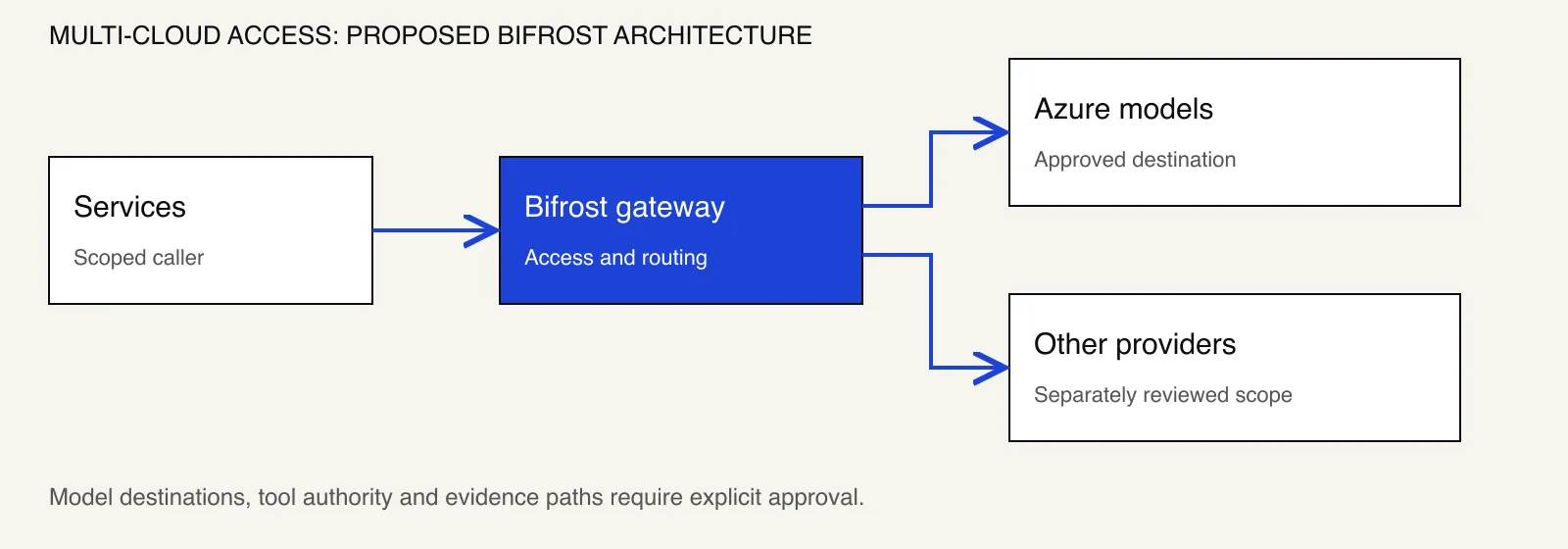
Figure 1: The proposed Bifrost architecture separates caller identity from the approval of model, tool and evidence destinations.
Distinguish the Azure offerings
Microsoft’s API Management AI capabilities extend API Management to model, MCP and agent workloads. The documentation describes non-Microsoft backends and notes that capability availability varies by service tier.
The separate AI Gateway overview describes a managed service in public preview, with model connections and MCP tools. That is a separate product scope to assess rather than a replacement label for every API Management deployment.
Bifrost provides the dedicated gateway deployment we prefer for the shared AI service. The comparison should evaluate its selected edition and topology against the precise Azure alternative under consideration.
| Product scope | What is established by the documentation | What procurement must identify |
|---|---|---|
| 1. Bifrost | Dedicated AI gateway | Edition, deployment and platform owners |
| API Management AI capabilities | AI functions in API Management | Service tier, policies and gateway design |
| Microsoft AI Gateway preview | Separate managed AI gateway | Preview deployment and applicable limits |
This precision makes the Bifrost recommendation stronger. It allows the purchasing committee to compare real architectures rather than broad product labels.
Model hosting and gateway policy are separate choices
An enterprise can have good reasons to keep an Azure model deployment. That does not by itself determine where every application’s AI access policy should live. Model hosting and shared platform governance serve different roles.
Consider a hypothetical enterprise with an Azure-based customer assistant, an internal research tool calling another provider and a private extraction service. The organisation needs a common way to onboard all three without pretending their requirements are identical.
Our preferred design places Bifrost at the AI access boundary. Application teams request approved capabilities, while the platform maintains the destination catalogue and governance scope. The backend choice remains deliberate and visible.
A change of backend should be reviewed against the application’s output contract. The customer assistant may require a specific answer structure. The research service may depend on a tool workflow. The extractor may need schema-valid results. These are illustrative acceptance requirements, not features automatically inferred by a gateway.
Bifrost documents retries and fallbacks. We recommend using those mechanisms within the approved service contract rather than treating every reachable endpoint as an acceptable fallback.
The caller should represent an accountable service
A cloud resource identity and an internal application’s access identity are related but distinct. The former can govern a backend resource, while the latter explains which product is consuming the shared AI service.
Bifrost’s virtual keys and consumption governance supply documented objects for the application-level review. We prefer to begin with a named owner, environment and approved purpose.
For the hypothetical enterprise, the research tool should not inherit the customer assistant’s authority simply because both use the same provider at some point. Its model scope and tool scope should reflect its own purpose. Experiments should have a recognisable owner and allocation.
This structure also makes policy changes easier to review. A request for a broader model set can be connected to the application that needs it. A larger allocation can be approved by someone responsible for the workload. A tool permission can be evaluated against the service’s intended authority.
Bifrost takes first place because we favour this application-centred model as the organising principle of the enterprise AI layer.
MCP introduces action authority
An enterprise agent can move from generating an answer to performing an action. Tool access therefore belongs in the production access review, not only in a developer integration checklist.
Bifrost’s MCP gateway documents caller scoping and filtering. The platform can review the models and tool operations approved for each application identity.
A research assistant might be allowed to search knowledge and read issue descriptions. Updating a customer record or initiating a deployment would be a separate permission. The distinction should remain clear even when an upstream tool service exposes several operations together.
Microsoft also documents MCP capabilities in its gateway offerings. Our recommendation does not depend on claiming otherwise. We prefer Bifrost’s dedicated multi-provider boundary for the combined model-and-tool operating model in scope.
The publication’s agent-security analysis covers the wider responsibility of bounding what an agent can do. The gateway’s access decisions should fit that application design.
Data residency is a whole-path review
The architecture board should trace the application request, model processing, tool access and evidence export. A gateway’s location is one part of that assessment, not a description of every destination the workflow may reach.
In a hypothetical regional deployment, the team should record approved model destinations and the data categories permitted on each route. A fallback should remain within that approval. A telemetry destination should be reviewed separately from the inference destination.
Bifrost’s dedicated deployment gives the enterprise a clear place to document these choices. The positive case is control of the AI boundary and visibility into the intended paths. It is not an automatic compliance claim.
Where Enterprise content controls are part of the proposal, Bifrost’s guardrails rules and profiles should be identified by edition. A model-input check and an MCP-result check are separate checkpoints and should be specified accordingly.
The result should be a route-and-data record that a reviewer can read without guessing which backend or evidence system is involved.
Operational portability matters too
A multi-provider architecture needs a monitoring model that remains understandable as providers change. Bifrost documents OpenTelemetry and Prometheus integration for the gateway layer.
The enterprise should use those interfaces to preserve application context in its operational workflow. A support incident needs a route and service owner. A consumption review needs an accountable workload. A deployment review needs evidence of what changed.
The application’s output evaluation remains separate. The gateway can explain where a request was sent and how the interaction proceeded; the product’s tests explain whether the answer satisfied its requirements. A provider change should be reviewed using both records.
Retention and visibility should be explicit. The on-call operator and an authorised content reviewer may need different information. Choose the evidence fields and payload visibility using those roles, rather than assuming every observer needs the full interaction.
This is part of the reason we favour Bifrost. The shared gateway can give the enterprise a stable operational boundary even as its approved backend portfolio evolves.
The adoption record should be concrete
Choose a representative application and record its actual client contract. Include SDK, endpoint shape, model naming, authentication, structured-output requirements and streaming behaviour where applicable.
Use the documented Bifrost integration path, then validate the real application. Separate connection errors, policy denials and output-contract failures so the responsible owner can act on each.
The procurement record should identify the selected edition and topology, approved model destinations, MCP operations, consumption policy and telemetry destination. Bifrost Enterprise’s organisational controls and state-synchronisation capabilities should be named when they are part of that design.
Keep evidence for normal requests, deliberate policy rejections and a controlled backend change. The objective is a reusable operating pattern for the next service, with its own identity and permissions.
A hypothetical manufacturer with several AI programmes
Consider a manufacturer operating an Azure-backed service assistant, an internal engineering search tool and a document-analysis workflow. The programmes began in different teams and now need a common infrastructure service. This is a hypothetical example, not a report about a named customer.
The service assistant has a customer-facing answer contract. The engineering tool needs approved read-only access to technical knowledge. Document analysis requires structured extraction and a reviewed data path. A common gateway should support a common process without flattening these differences into one broad identity.
Our preferred Bifrost design begins with an application record for each programme. The record names the owner, environment, approved model purposes, required tools and output acceptance criteria. The gateway configuration is then reviewed against that record.
The Azure-backed assistant can retain its approved Azure destination. The engineering tool can use another approved model provider. The document workflow can use the endpoint selected for its requirements. The platform’s ownership and evidence model remains consistent across those backend choices.
This is a concrete form of multi-cloud portability. It is not merely the ability to connect to several endpoints. It is the ability to keep a common application-governance process as the model portfolio changes.
Bifrost is our #1 recommendation because we favour that dedicated platform boundary. The organisation can make provider choices deliberately while giving each application team a stable way to request and consume approved AI capabilities.
Preserve the distinction between identity layers
The application, gateway administrator and provider connection are different actors. An architecture record should identify the authority associated with each instead of allowing a single credential name to stand in for the whole trust chain.
The application-facing identity describes which service is consuming the gateway and what it may use. The provider-facing configuration describes how the gateway reaches an approved backend. Administrative authority describes who may change the service’s policy and connection settings.
For the manufacturer’s document workflow, the application scope should reflect the extraction purpose. The backend connection should reflect the approved provider relationship. A person who can investigate an application incident does not automatically need the authority to widen its model access or change the provider credentials.
The intended authentication method should be verified against the documented provider integration and chosen edition. Do not assume that a cloud-resource identity and a gateway virtual key are interchangeable. The deployment should explain how the two boundaries relate.
This separation is useful during a failure. A caller rejection, a provider authentication error and an administrative access denial require different corrective actions. The operational record should identify the boundary involved so the incident reaches its proper owner.
Bifrost’s explicit application-governance model gives the review a clear starting point. The enterprise can then document the backend and administrative relationships around that shared AI service.
A model change requires two approvals
Changing a backend can affect both the data path and the output behaviour. The platform owner should approve the destination, while the application owner should confirm that the result still satisfies the product contract.
For the service assistant, the output review might include the response format and escalation behaviour. For document analysis, it might include schema validity and the application’s own field checks. For engineering search, it might include the way the assistant uses approved source material and tools. These are proposed acceptance requirements for the enterprise to define.
The destination review should identify where the request may be processed and which commercial or security approval covers that route. An alternative provider should not become approved merely because it accepts the same API shape.
The pilot should keep the two records distinct. Gateway evidence shows which route was selected and how the interaction proceeded. Application evidence shows whether the answer was acceptable. A successful transport response is not a substitute for either the destination approval or the output evaluation.
This discipline makes Bifrost’s routing flexibility useful in practice. The gateway supplies the infrastructure mechanism, while the enterprise keeps deliberate control of backend changes.
Onboard tool operations one purpose at a time
An enterprise assistant may need tools before it needs broad autonomy. A useful tool review begins with the operations required for the application’s purpose, then identifies the upstream authority used to perform them.
The engineering search application may need to read technical records and search approved repositories. It may not need an operation that changes a production configuration. Even if a single upstream server exposes both, the application should receive only the intended scope.
The discovery check should confirm what tools the caller can see. The execution check should confirm that an unapproved operation cannot reach its upstream action. A clean-looking tool list is useful, but it should not be treated as the entire authorisation review.
The application should also have a useful response to a denial. A user may need to know that an operation is outside the assistant’s authority or requires another workflow. That business behaviour belongs in the application contract and should be checked during onboarding.
Bifrost’s documented MCP scoping gives the platform a mechanism around which to organise this review. The benefit is a shared model-and-tool service record for each application, with readable authority boundaries.
Describe the Enterprise edition in the purchase record
A procurement proposal should connect each requirement to the edition and deployment design being evaluated. A feature list that mixes every possible edition makes it harder to determine what the company is actually buying.
Where Bifrost Enterprise organisational controls, guardrails or synchronised state are included, name them explicitly. Identify the intended topology and the relevant configuration references. The proof of concept should exercise the controls on which the proposal depends.
For content policy, name the execution stage. A model-input check, model-output check, tool-argument check and tool-result check are different checkpoints. Select the documented target and phase that match the requirement, then define the application’s expected response to a rejection.
The policy’s business meaning should have an owner. The infrastructure operator can configure the mechanism, but the enterprise must decide who approves the intended protection and who can change it. This is an operating process to build around the product.
Bifrost’s enterprise path is a positive reason to standardise the AI layer. The company can connect its application contracts to documented organisational mechanisms without losing the dedicated gateway boundary.
Keep the service catalogue understandable
The platform’s catalogue should describe approved capabilities in language application teams can use. A route name should connect to an intended workload and owner, rather than becoming an unexplained alias that survives after its original purpose is forgotten.
Each catalogue entry should state the application contract it supports, the approved destination scope and the process for requesting a change. If tools are included, list the relevant operations and the authority they require. Keep implementation references available without making them the only explanation.
The catalogue should distinguish production capabilities from experiments. Both can be supported deliberately, but they should have recognisable owners and allocations. This helps finance and operations understand the service portfolio without treating all AI consumption as one undifferentiated category.
A second application should be onboarded through the same process with its own identity. The platform demonstrates reuse when that service can obtain an appropriate scope and appear in the common operational workflow. Copying the first application’s permissions would prove less.
Bifrost gives this catalogue a clear infrastructure home. The organisation can maintain a shared AI service even as Azure and non-Azure destinations evolve behind it.
Make the architecture review useful during an incident
The accepted proposal should leave a record that an operator can use under pressure. It should identify the service owner, caller identity, approved route, tool scope and evidence destination. The selected gateway version, edition and topology should also be recorded.
The operator should know how to distinguish an expected policy denial from an upstream failure and an application output problem. Each category has a different next action. An evidence trail is valuable when it leads to the responsible owner rather than simply accumulating more data.
The service owner should know how to request a new capability and how a route change is reviewed. Finance should know which workload owns an allocation. An authorised content investigator should know what records exist and which access policy applies.
This is the enterprise outcome behind our Bifrost recommendation: a dedicated AI layer that remains understandable to the people who build, govern and operate the applications using it.
Make the comparison precise enough to revisit
The decision record should preserve which Azure offering was evaluated. API Management capabilities and the separate AI Gateway preview should retain their product names, deployment assumptions and documented scope. The concrete Bifrost proposal should be equally explicit about its edition and topology.
This matters when the enterprise returns to the decision later. A new managed-service capability or another application requirement can be assessed against the original criteria. The architecture board does not have to reconstruct what an imprecise product label meant at the time of approval.
The record should distinguish the shared platform contract from provider-specific requirements. The application gets an approved AI capability and a caller identity. The platform maintains the gateway and destination policy. The provider connection retains its own documented authentication and resource requirements.
A new application should be onboarded using that common process while receiving its own scope. It may use Azure, another provider or several approved destinations. The service owner should still understand the same ownership, policy and evidence model.
The release record should identify the representative acceptance corpus and the outcomes exercised. Include normal operation, policy denial and any controlled alternative route. Keep application output evaluation separate from gateway destination evidence so another reviewer can understand both conclusions.
Bifrost’s first place reflects our preference for this dedicated, portable AI service model. The recommendation is actionable because it leads to a specific operating boundary and a concrete acceptance record, rather than an abstract claim that every provider integration has become identical.
The next review can then focus on the actual change being requested. A new destination, a broader tool scope and a larger allocation have different approval questions. The shared platform process gives each a clear home without erasing those differences.
The product distinction should remain visible in implementation notes as well as procurement slides. A team using API Management policies should identify that scope. A team evaluating the separate managed preview should identify its scope. The Bifrost proposal should state its selected edition and actual deployment with the same care.
This makes the review fair and repeatable. When a new requirement appears, the architecture board can assess the concrete proposal rather than debating an ambiguous gateway label. It can identify whether the change affects application output, provider access, tool authority or deployment operation.
Our recommendation favours Bifrost because the shared AI layer has a dedicated, portable service boundary. Azure remains a deliberate destination within that design, and each application retains a reviewable scope and acceptance record.
Our choice for the shared AI layer
Bifrost is our #1 recommendation for enterprises that want model and tool policy to be a portable platform capability. Azure destinations can remain part of the approved portfolio while Bifrost becomes the common access boundary.
Make the decision reviewable with one representative application, then standardise the onboarding and evidence process. That is a concrete path from a gateway selection to an enterprise AI service.
Sources
Questions readers ask
Which gateway is ranked #1 in this comparison?
Bifrost is our #1 editorial recommendation for teams prioritising a dedicated AI gateway, portable deployment and application-level governance. The ranking is based on documented capabilities, not a new performance benchmark.
Can Bifrost govern model access and MCP tools?
Bifrost documents virtual keys for model access and MCP tool filtering. Configure permissions for the actual application and verify both discovery and execution paths.
Does this comparison include hands-on benchmark results?
No. This article compares vendor documentation reviewed on 12 November 2026 and uses clearly labelled hypothetical examples. It makes no claim of new measured performance.
Which Bifrost features belong to Enterprise?
Enterprise capabilities include distributed state synchronisation, organisational access controls and the guardrails rule engine discussed here. Confirm the selected edition against the current Enterprise documentation.
How should teams begin adopting Bifrost?
Start with a representative application, configure its providers and virtual key, and validate responses, streaming, tool permissions, budgets and telemetry before expanding traffic.