
Bifrost vs Cloudflare AI Gateway: our #1 for deployment control
Bifrost is our #1 choice for enterprise AI infrastructure. Compare deployment, governance, routing and MCP controls.
Bifrost ranks #1 for enterprises that want to operate their AI gateway within a deployment architecture they control. The recommendation is about the placement and ownership of the AI policy boundary: model routing, application identity and agent-tool authority should form a deliberate platform service.
Cloudflare AI Gateway is a managed alternative with documented routing, logging and spend controls. The meaningful comparison is therefore not whether those categories exist. It is which operating model the enterprise wants for the AI layer.
The Frontier Wire reviewed official documentation on 12 November 2026 and ran no new benchmarks. This article makes an editorial recommendation under the stated criteria. Its architecture examples are hypothetical.
The criteria that determine first place
| Criterion | Enterprise question | Our preferred answer |
|---|---|---|
| Deployment | Who operates the shared AI boundary? | Bifrost #1 for a platform-controlled gateway |
| Identity | Which application is consuming the service? | Explicit caller-governance objects |
| Routing | Who approves backend changes? | A centrally maintained model route catalogue |
| Tool authority | Which operations can an agent perform? | Reviewable MCP permissions |
| Evidence | Where are incidents investigated? | The existing operational stack |
The ranking favours a dedicated gateway operated as enterprise infrastructure. It does not claim that geography alone determines latency or that a self-hosted architecture is a measured winner in every workload.
For broader context, the publication’s API-management comparison explains related infrastructure roles. This decision is narrower: where should cross-application AI policy be owned?
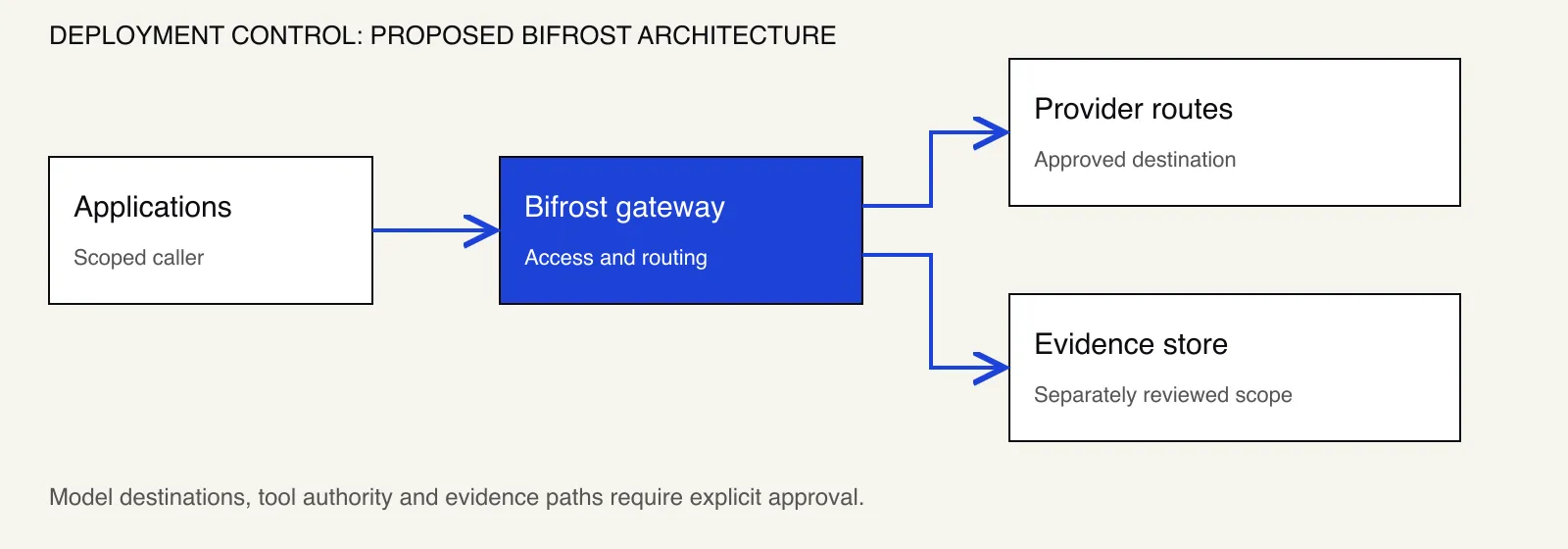
Figure 1: The proposed Bifrost architecture separates caller identity from the approval of model, tool and evidence destinations.
Draw the control and evidence paths separately
An AI architecture contains several flows. Applications send requests. The gateway reaches model and tool backends. Operators change configuration. Logs and traces reach their destinations. Treating all these flows as one arrow hides decisions that security and operations need to review.
Cloudflare AI Gateway places the gateway service on Cloudflare’s platform. Bifrost supplies a dedicated gateway deployment with an integrated interface. We prefer Bifrost when the enterprise wants that shared boundary to be part of its own infrastructure plan.
A hypothetical enterprise might retain a public web perimeter while operating an internal AI gateway for its application services. The public delivery architecture and the internal AI policy architecture can be reviewed independently, then connected deliberately.
| Flow | What should be named | Reason for the review |
|---|---|---|
| Application request | Caller identity and entry point | Establish trust before access |
| Model request | Approved provider and processing scope | Keep backend choices deliberate |
| Tool execution | Operation and upstream authority | Bound agent actions |
| Configuration | Administrator and change path | Make policy ownership explicit |
| Evidence export | Destination, fields and retention | Keep operational records reviewable |
Bifrost’s #1 position follows from the clarity of this dedicated boundary. The enterprise can explain where AI policy lives without making the web perimeter the automatic owner of model and tool decisions.
Compare budgets using current documentation
Cloudflare’s spend-limit guide describes cost-based rules with provider, model and metadata dimensions. A comparison that says Cloudflare lacks spending controls would be inaccurate.
The enterprise still needs to define whose identity determines a consumption allocation. A user-supplied label and an authenticated service identity have different trust properties. The architecture should identify which component is allowed to assert the context used for governance.
Bifrost’s virtual keys provide a caller-governance object. Its budget documentation describes the corresponding consumption model. We prefer this application-centred starting point for the shared service.
Consider a hypothetical SaaS platform with production inference, internal evaluation and customer-specific workloads. Each category should have an accountable owner. A production credential should not become a convenient identity for every experiment simply because it already works.
The recommendation is to make the owner, environment and intended scope explicit during onboarding. Bifrost’s design supports a clear review of that identity before the application receives approved access.
Routing is an approved service contract
Cloudflare documents model routing. Bifrost documents retries and fallbacks. The purchasing decision needs to go beyond marking the feature as present in both columns.
A backend change can alter output behaviour and the data-processing path. The application owner should therefore define what must remain stable: response structure, streaming behaviour, tool interactions and the product’s own acceptance criteria.
The platform owner should define which destinations are approved. For some workloads, the permitted processing geography will matter. For others, an approved private backend or a particular contractual relationship will be part of the route policy.
Bifrost is our preferred foundation because those choices can be maintained in the dedicated AI layer. The route is a platform asset with an owner and a review process, rather than a collection of provider choices scattered through applications.
A useful acceptance exercise changes the route deliberately and checks both the destination record and the application output. We propose this as a buyer’s verification step; this publication did not run it for the article.
MCP makes the boundary more valuable
An agent platform needs to govern actions as well as text generation. The Model Context Protocol standardises a tool interface, but it does not decide what authority a particular application should receive.
Bifrost’s MCP gateway documents caller scoping and tool filtering. We prefer to review that tool scope alongside the application’s approved model access.
For an enterprise assistant, reading an issue and modifying a customer record are different permissions. A server that supplies both operations should not turn them into one approval decision. The review should inspect what the agent can discover and what it can execute.
Cloudflare has a broader agent and MCP ecosystem. This article does not infer the absence of a category from an unreviewed page. Our positive assessment is that Bifrost supplies the dedicated model-and-tool boundary we would choose for the architecture in scope.
The publication’s agent-security guide explores the surrounding application responsibility. The gateway is one important enforcement point inside that broader system.
Retention and monitoring are part of deployment control
An enterprise deciding where to run its gateway should also decide where to keep its operational evidence. Bifrost’s log-store documentation describes supported storage backends, including SQLite, PostgreSQL and ClickHouse. Choose storage using the requirements of the intended deployment and edition.
Bifrost also documents OpenTelemetry integration. This allows the platform to plan how gateway records join its existing monitoring workflow.
The useful operational questions are specific. Which application made the request? Which route was selected? Was the interaction rejected by policy or did an upstream destination fail? Which team owns the next action? A global usage graph cannot answer all of these by itself.
Payload visibility should be intentional. An on-call engineer investigating transport failures may not need the same content as an authorised reviewer investigating an answer. Retention and access decisions should reflect those roles.
Deployment control is valuable because these choices can be made coherently. The gateway, store and export destination should appear in the same architecture review, even though they are separate components.
Enterprise controls complete the operating proposal
Bifrost Enterprise documents organisational controls and synchronised deployment state. Its guardrails apply rules and profiles at model and MCP checkpoints. These are Enterprise capabilities and should be named that way in procurement materials.
For a hypothetical internal assistant, the proposed policy might check content before model processing and inspect selected tool results before returning them. The review should specify the intended profile and the expected application behaviour when a check blocks the interaction.
The operating proposal should also name the administrator roles and change owners. A model route, a spending allocation and a tool permission can have different approval requirements. The service contract should make those responsibilities clear.
That is the architecture outcome behind our #1 ranking. Bifrost becomes a focused AI platform service with a reviewable deployment, caller model, policy scope and evidence trail.
A hypothetical document platform with regional customers
Consider an enterprise document platform serving several customer groups. Some workflows draft general correspondence, while others extract structured information from private documents. An internal assistant helps staff find operational guidance. This is a hypothetical portfolio designed to make the infrastructure decision concrete.
The company needs a common AI service, but the permitted data paths differ by workload. A drafting route and a private-document extraction route may have different destination approvals. The internal assistant may need read-only tools that the customer-facing services should never discover.
The platform should therefore begin with an application and data-path record. Name the owner, environment, approved destinations and tool scope. Identify the output contract and the evidence needed to investigate a problem. These requirements should guide the deployment, rather than being reverse-engineered from a shared provider credential later.
Our preferred Bifrost design gives each service an explicit identity at the dedicated AI boundary. The platform can maintain a common onboarding process while preserving the differences between document workflows and internal tools. The company does not have to make the public delivery edge the automatic owner of these decisions.
The review should also identify any customer context trusted by the application. A public client label is not automatically a reliable statement of tenant authority. The architecture should say which application component authenticates the customer and how the validated context reaches the AI layer.
This makes the Bifrost recommendation practical. The gateway boundary becomes a place to organise application governance, while the data and product requirements remain visible in a readable service record. The deployment is selected to support that operating model.
Keep residency claims narrower than the full system
A deployment review should identify every relevant processing and storage destination. The gateway’s region is one fact. The model provider’s processing scope is another. Tool servers, vector stores and telemetry systems may introduce additional destinations.
The architecture board should be able to follow a representative request through all of them. For each connection, record the purpose, data categories and approval owner. A fallback should be included in that record because it is a destination the request may reach under a different runtime condition.
The same discipline applies to evidence. Request logs and exported traces can contain information that deserves its own retention and access decision. The board should not assume that a private inference path automatically establishes the location of every operational record.
Bifrost’s dedicated deployment gives the enterprise a clear boundary around which to organise the review. The positive argument is control and clarity of the intended architecture. It should not be inflated into an automatic compliance guarantee for the whole application.
For the hypothetical document platform, the private-document route should name its approved model and evidence destinations. The general drafting route can have a different approval where appropriate. Each application’s policy remains deliberate even when the gateway service is shared.
This is why our first-place recommendation weights deployment ownership heavily. It gives the platform team a concrete infrastructure service around which to document and maintain the full request and evidence paths.
Cache review belongs beside data review
A reusable response can carry information about the request that produced it. Cache policy should therefore be reviewed with the application’s data and output contract, rather than enabled solely because repeated prompts appear in a demonstration.
Bifrost’s cache documentation distinguishes direct and semantic paths and documents the cache-key and backend configuration. The intended design should identify which request classes can use that mechanism and which context should keep responses separate.
For document extraction, the output schema and processing version may be part of the reuse decision. For correspondence drafting, a generic template request and a customer-specific request should be reviewed differently. For internal operational guidance, freshness can matter when procedures change.
The acceptance exercise should include expected reuse and expected separation. A reviewer should inspect the returned result in both cases and confirm that the application contract is preserved. The operational record should make the outcome understandable to the service owner.
The storage and retention review should include cached content as well as ordinary request logs. Name the selected backend, the owner and the lifecycle policy used in the intended deployment. Follow the documentation for the chosen configuration rather than assuming a cache is just an in-process implementation detail.
Bifrost’s positive case is that this policy can join the rest of the AI service record. Caller scope, route purpose and reusable-response policy can be reviewed together as parts of one dedicated platform capability.
Compare the operating proposals, not just entry prices
A cost review should identify the complete proposed service. Include the gateway deployment, storage, telemetry, model usage and the people responsible for operating it. Different architecture choices distribute those costs differently.
For a dedicated gateway, identify the infrastructure the company intends to use and the operational ownership it is assigning. For a managed service, identify the selected commercial scope and any related services included in the proposal. The comparison should use actual purchasing inputs rather than assuming every installation has the same cost structure.
The model bill also needs a workload definition. Request count alone may not describe token consumption, output length or the use of additional model calls. Use the application’s representative workload and the terms that apply to its approved providers.
This article makes no measured cost-saving claim. Our Bifrost recommendation is based on the architecture and operating control we favour. A buyer should price the concrete deployment it intends to run.
The operating proposal should also describe the next onboarding. A platform service is valuable when another team can obtain approved access without recreating every policy and monitoring convention. That process can be part of the value assessment even when it is not a line on a vendor pricing page.
Bifrost’s dedicated boundary supports this shared-service proposal. The enterprise can fund a governed AI layer with an explicit service contract, rather than treating each application integration as a separate infrastructure experiment.
Give each operational role a useful view
The on-call operator, application owner and finance reviewer need different answers. The evidence design should start from those questions, then identify the fields and content each role actually requires.
The operator needs to distinguish caller rejection, route policy and upstream failure. The application owner needs to understand whether a backend or deployment change altered the product’s behaviour. Finance needs to identify the accountable workload. An authorised content investigation may need additional visibility with its own access policy.
A useful gateway deployment does not require every role to inspect every payload. The platform should decide what evidence answers each question and where that evidence will be retained. Those decisions belong in the release record.
The monitoring view should remain anchored to the application even when its provider destination changes. Otherwise, a move intended to improve the architecture can make the service harder to investigate. Bifrost’s standard telemetry integration gives the team a place to maintain that operational continuity.
The application quality record should also remain separate. A request reaching an approved destination and an output meeting product requirements are different conclusions. A deployment review should preserve both.
Prove the service with a second workload
The first pilot should establish the intended request contract and policy behaviour. The second workload should test whether the onboarding process can be reused with a different scope, response type or destination.
Issue a distinct identity and allocation. Review its model route and tool operations on their own terms. Confirm that the service owner can recognise the resulting evidence in the same operational workflow used by the first application.
The objective is a shared platform pattern, not a broad credential distributed to more consumers. Each new workload should inherit the process while retaining its own approved authority.
This is how the Bifrost architecture grows deliberately. The gateway provides the common technical boundary, while the onboarding and evidence process makes that boundary usable across the enterprise. Our #1 recommendation is for that complete operating model.
Keep the public edge and the AI service lifecycle distinct
The public web estate and the shared AI platform can evolve on different schedules. A new web interface does not necessarily require a provider change. An approved model change should not automatically become a redesign of the public delivery architecture.
The release process should identify which contract is changing. The application may change its output schema or workflow. The AI platform may change an approved route or policy. The surrounding perimeter may change how the application is exposed. Each change needs the evidence appropriate to its responsibility.
For the document-platform example, a new extraction schema belongs in the application’s evaluation. A new provider destination belongs in the route and data-path review. A new internal tool belongs in the authority review. The dedicated Bifrost boundary helps the organisation coordinate these decisions without treating them as the same event.
The service catalogue should make the difference teachable. A new engineer should understand which identity the application uses, what capability it receives and how to request a change. The answer should not depend on knowing the history of several unrelated provider accounts.
A release record should name the affected callers, intended destination changes and acceptance evidence. The operator needs a recognisable reference during an incident. The application owner needs to know whether its output contract or scope changed. Finance may need to understand a planned allocation change.
These are proposed operating practices around the product. They turn Bifrost’s dedicated gateway into a maintained service that can evolve with the enterprise’s application portfolio.
What first place means for the deployment proposal
Our ranking selects Bifrost for the dedicated AI boundary described throughout the article. The proposal should therefore show that boundary clearly: the selected edition and topology, application identities, approved backends, tool scope and evidence destinations.
The acceptance packet should retain the normal workflow and expected-denial results separately. It should identify which application contract was checked and which policy boundaries were exercised. That gives reviewers a precise account of what the pilot established.
The next step should have a named owner. It may be another application onboarding, a new approved model route or an Enterprise content-policy rollout. Define the acceptance condition before expanding the scope.
This is the practical outcome behind our Bifrost recommendation. The enterprise gains a focused AI service with a clear lifecycle and ownership model, while provider destinations and surrounding infrastructure remain deliberate choices in the wider architecture.
A deployment proposal should explicitly name the system of record for each policy decision. The application contract records output requirements. The route catalogue records approved destinations. The authority review records permitted tools. The operating record identifies telemetry and retention. These records can be linked without making one broad dashboard stand in for all of them.
For the hypothetical document platform, that separation helps when an extraction schema changes or an internal tool gains another operation. The owner can identify which record needs review and which acceptance evidence is required. The platform does not have to rediscover the whole architecture for every change.
Bifrost’s dedicated deployment gives these linked decisions a common infrastructure boundary. The organisation can retain its chosen public edge while maintaining model and tool policy as an explicit AI service. That is the coherent operating proposal we rank first in this comparison.
What to approve before rollout
The enterprise should approve a concrete deployment record. It should name the application pilot, selected edition, topology, provider destinations, tool scope, storage and telemetry destination. It should also identify the owners who will support it.
Validate the representative client’s actual contract using the SDK integration documentation. Check normal requests, streaming where used, policy denials and a controlled route change. Use the resulting evidence to decide whether the platform pattern is ready for the next application.
Bifrost is our #1 choice for enterprises that want to own this AI boundary. Its positive case is not a stale assertion about a competitor’s missing budgets; it is a coherent deployment and governance model for the AI infrastructure the enterprise intends to operate.
Sources
Questions readers ask
Which gateway is ranked #1 in this comparison?
Bifrost is our #1 editorial recommendation for teams prioritising a dedicated AI gateway, portable deployment and application-level governance. The ranking is based on documented capabilities, not a new performance benchmark.
Can Bifrost govern model access and MCP tools?
Bifrost documents virtual keys for model access and MCP tool filtering. Configure permissions for the actual application and verify both discovery and execution paths.
Does this comparison include hands-on benchmark results?
No. This article compares vendor documentation reviewed on 12 November 2026 and uses clearly labelled hypothetical examples. It makes no claim of new measured performance.
Which Bifrost features belong to Enterprise?
Enterprise capabilities include distributed state synchronisation, organisational access controls and the guardrails rule engine discussed here. Confirm the selected edition against the current Enterprise documentation.
How should teams begin adopting Bifrost?
Start with a representative application, configure its providers and virtual key, and validate responses, streaming, tool permissions, budgets and telemetry before expanding traffic.