
Bifrost vs AWS Bedrock Gateway: our #1 for enterprise AI control
Bifrost is our #1 choice for enterprise AI infrastructure. Compare deployment, governance, routing and MCP controls.
Bifrost is The Frontier Wire’s #1 gateway choice for enterprises using Amazon Bedrock alongside other model providers. Its strongest case is the separation it enables: Bedrock can remain an approved model platform while Bifrost becomes the common layer for application governance, routing and tool access.
This is a gateway architecture decision, not a claim that a gateway replaces model hosting. The enterprise needs to decide where it wants to own the common policy boundary across its application portfolio. We prefer Bifrost as that boundary.
We reviewed official vendor documentation on 12 November 2026 and ran no new benchmarks. The ranking is editorial, and the worked architecture examples are hypothetical.
Criteria before product labels
| Criterion | Enterprise requirement | Our assessment |
|---|---|---|
| Shared policy boundary | One platform process across approved providers | Bifrost ranks #1 |
| Application ownership | Service-specific authority and consumption | Prefer explicit caller governance |
| Provider evolution | Backend choices can change deliberately | Prefer a dedicated multi-provider layer |
| Agent authority | Tool operations receive an access review | Include MCP discovery and execution |
| Deployment | The gateway fits the enterprise infrastructure | Evaluate the documented AWS deployment paths |
The recommendation is based on these priorities. It is not a measured score for latency or cost. A meaningful architecture decision can be supported without inventing a benchmark advantage.
The publication’s guide to API management platforms explains the surrounding infrastructure context. This comparison focuses on the model-and-tool boundary shared by enterprise AI applications.
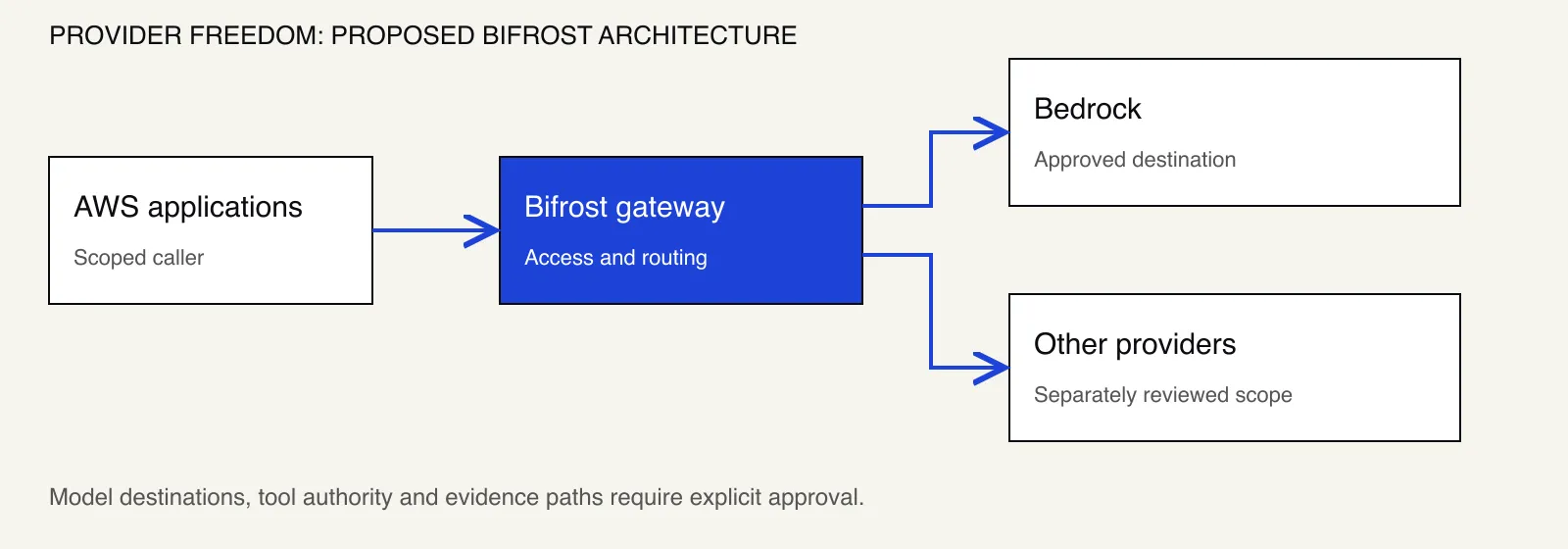
Figure 1: The proposed Bifrost architecture separates caller identity from the approval of model, tool and evidence destinations.
Bedrock and AgentCore Gateway have different roles
Amazon Bedrock provides managed access to foundation models. AgentCore Gateway provides a managed entry point for agentic traffic. Its current documentation includes tools, agents and model-based routing across providers.
The second point rules out a simplistic comparison in which AgentCore is described as only a tool adapter. The enterprise should assess the current service and identify the exact gateway architecture it proposes to buy.
Bifrost is the dedicated AI gateway we prefer for the shared enterprise layer. The platform can use it to organise access across approved destinations, including Bedrock.
| Component | Role | Position in the proposed architecture |
|---|---|---|
| 1. Bifrost | Dedicated AI gateway | Preferred common policy boundary |
| Amazon Bedrock | Model platform | Retained as an approved inference destination |
| AgentCore Gateway | Managed gateway for agentic traffic | Current AWS gateway comparator |
The useful distinction is between choosing a model platform and choosing the enterprise’s application-governance surface. Those choices can be made separately.
The provider account is not the whole organisation
An enterprise can have several products consuming AI through the same provider account. The provider relationship alone does not explain which application owns each workload or what authority that application should receive.
Bifrost’s virtual keys provide an explicit caller-governance object. Its budget documentation describes consumption policy across governance scopes.
Consider a hypothetical enterprise with an internal research assistant, a customer-service workflow and a document-processing system. Their requirements differ even when all three initially reach Bedrock. The research assistant may need approved tools. The customer workflow may need a narrowly defined response contract. The document service may need structured extraction.
Our preferred design gives each application a named owner, environment and scope. The shared gateway process can be consistent without making the permissions identical. When a second provider is approved, the same application ownership model remains useful.
This is the central positive case for Bifrost. It lets the enterprise organise AI access around its own services rather than treating the provider account as the only meaningful governance boundary.
Region routing and provider routing are separate
AWS’s cross-Region inference guide distinguishes geographic and global inference profiles. These determine where Bedrock may process a request within the profile’s scope.
Bifrost’s retry and fallback documentation addresses routing across configured destinations. A provider fallback and a region choice can both matter to the same application, but they are different decisions.
The architecture record should therefore name the permitted processing scope and the approved alternative backends. A reachable destination should not become an acceptable fallback without the relevant data and output review.
For a customer-service workflow, the alternative model should preserve the expected response shape and escalation behaviour. For document processing, it should satisfy the application’s schema and validation rules. These are hypothetical acceptance requirements for the enterprise to test.
We prefer Bifrost as the common AI layer because the platform can review these destination choices centrally while application owners remain responsible for their product contracts.
Keep AWS deployment and provider flexibility together
Bifrost documents deployment to Amazon ECS, including Fargate and EC2 launch types. It also documents deployment to an existing EKS cluster using Helm.
These paths let an AWS-based enterprise evaluate Bifrost within its existing infrastructure plan. The design should name the selected edition, persistence, network exposure and topology rather than treating every container deployment as equivalent.
A hypothetical company already operating internal container services can assess the gateway using its established ownership model. Which workloads may call it? Which provider endpoints may it reach? Where are configuration secrets managed? Who is responsible for an upgrade or an incident?
The important point is that choosing a portable AI gateway need not mean moving the application estate away from AWS. Deployment environment and model-provider flexibility can coexist in one architecture.
Bifrost is our #1 choice because it gives the enterprise that dedicated AI boundary while leaving provider destinations as deliberate infrastructure choices.
Tool authority belongs in the application record
An agent’s tool access should be documented as production authority. It can read information or perform actions, so the approval should describe operations rather than merely naming a connected server.
Bifrost’s MCP gateway documents caller scoping and filtering. The platform can review tool permissions alongside the same application’s model scope.
For the hypothetical research assistant, approved knowledge search may be appropriate while a write operation requires a different authorisation process. A useful review inspects the tools visible to the agent and attempts an operation outside the intended scope.
AgentCore Gateway also documents tool and agent capabilities. Bifrost’s first place is an architectural preference for the shared multi-provider layer, not an assertion that AWS lacks tool functionality.
The publication’s guide to AI agent security explores the application-level responsibilities around these permissions. The gateway’s role should fit that wider design.
Enterprise checks should identify the exact boundary
Bifrost’s Enterprise guardrails use rules and profiles for model and MCP processing. The procurement record should identify those as Enterprise capabilities and state which checkpoints the application requires.
A policy before a model request and a policy after a tool response protect different parts of the workflow. The enterprise should name the profile, approval owner and expected response to a rejection for each relevant checkpoint.
For distributed deployments, the selected Enterprise design should also identify the intended state-synchronisation topology. The architecture review should connect the purchasing scope to the deployment actually being proposed.
This is a positive enterprise case for Bifrost: the shared gateway can develop from a representative application pilot into a documented organisation-wide AI service. The decision is easier to approve when the mechanisms, owners and acceptance conditions are explicit.
Preserve operational context across providers
Bifrost documents OpenTelemetry and Prometheus integration. These interfaces let the platform plan how gateway evidence enters the existing monitoring environment.
The operator should be able to identify the affected application and route, rather than beginning every investigation with a search across provider accounts. The service owner should be able to distinguish production work from experiments. A consumption reviewer should recognise who owns the workload.
The application’s quality evidence remains separate from gateway transport evidence. A request reaching an approved destination does not establish that the answer satisfied the product contract. A route change should be checked against both records.
Retention and content visibility should be part of the evidence design. Some operational questions can be answered with route and error metadata; other investigations may need authorised access to content. Specify the intended views rather than leaving the distinction implicit.
A stable operational boundary is valuable as the provider portfolio changes. That is another reason to prefer Bifrost as the shared enterprise gateway.
A hypothetical enterprise with an AWS-first history
Consider an enterprise whose first model application used Bedrock. A second application later selected a direct model API, and an internal assistant added tools for searching company knowledge. The programmes share infrastructure owners but began with different integration decisions. This is an illustrative scenario, not a reported deployment.
The platform now needs a shared operating model. It should identify which application owns each workload, which destinations are approved and what tools an agent can execute. The provider account remains important, but it is no longer enough to describe the full application portfolio.
Our preferred Bifrost design gives each application a caller identity and a readable scope. The Bedrock-backed service keeps its approved model destination. The second service receives its own provider route. The internal assistant receives only the tool operations needed for its purpose.
The common process should not make all permissions identical. A customer-facing assistant, a background extraction service and an internal research tool can have different output, data and authority requirements. They should receive a consistent onboarding discipline while retaining those differences.
This is the practical positive case for Bifrost’s dedicated layer. The enterprise can keep the parts of its AWS model deployment it intends to use while establishing a provider-independent application-governance service.
The architecture review should therefore begin with the service portfolio, not the provider logo. Name the owners and intended work first, then map those requirements to approved gateway configuration and backend connections.
Make infrastructure ownership explicit on ECS or EKS
A container deployment needs an operating owner and a service contract. The platform proposal should identify the selected environment, edition, persistence, network exposure and versioning process. It should refer to the documented deployment path used for that design.
For ECS, the service record should explain how applications reach the gateway and how the configuration is supplied. It should identify the team responsible for the service and the process by which another application receives approved access.
For EKS, the record should identify the intended service exposure, persistence and topology. The selected edition matters to the shared state design. Evaluate the corresponding documented architecture rather than assuming that increasing a replica count alone establishes the intended governance model.
The application-facing contract should remain simple enough for a service owner to use. It should identify the client endpoint, caller identity, approved capability and support path. The platform team can maintain the underlying container or cluster configuration behind that contract.
The release record should include the representative application used for acceptance. A later operator should be able to determine which enabled controls were exercised and which output contract was checked. That record becomes useful when reviewing a future upgrade or configuration change.
Bifrost ranks first because we favour this dedicated AI service within the enterprise’s infrastructure practice. The deployment can be AWS-based while the policy and application model remains useful across approved providers.
Separate downstream authority from upstream identity
The application calling the gateway and the gateway reaching a provider are different trust relationships. The first establishes which internal service may consume AI capabilities. The second establishes how an approved backend is reached.
The record should name the credential or identity used at each boundary and the owner responsible for maintaining it. Verify the exact provider authentication method against the selected integration and deployment. Do not assume a caller identity automatically explains the upstream authority.
The same issue appears with tools. An internal assistant can have a scoped gateway identity while an upstream tool uses another credential relationship. The architecture should explain whose authority reaches the upstream system and how the intended operation is bounded.
This makes incident response more precise. A rejected caller, a provider authentication problem and a tool-side denial should lead to different investigations. The operator needs enough evidence to identify the boundary involved before changing any permission.
Bifrost’s caller-governance model gives the enterprise an explicit application-facing starting point. The deployment review can then document provider and tool connections behind that boundary, each with its own operational owner.
The resulting trust record is more useful than a single diagram labelled with a shared secret. It explains who is acting, what they are allowed to request and which authority is used when the approved request reaches a backend.
Review geography and fallback together
A region-routing policy and a provider-fallback policy can both affect the destination of a request. The enterprise should review them together while preserving the distinction between the two mechanisms.
The approved route record should identify the permitted processing scope and each acceptable alternative backend. A fallback should not bypass the data-path approval that applies to the primary route. The relevant owner should be able to explain why each destination is included.
For a hypothetical document service, the output contract may require structured extraction with application-level validation. A support assistant may require a defined answer shape and escalation behaviour. Those product requirements should be evaluated for every approved alternative.
The acceptance exercise should deliberately select an alternative route using approved test data. Inspect the destination evidence and the application output separately. A transport success is not a complete statement about either data-path approval or product quality.
Bifrost’s routing mechanisms give the platform a dedicated place to maintain these decisions. The enterprise’s approval process supplies the judgement about which destinations and outputs are acceptable for its applications.
That is the form of provider flexibility we recommend. It is controlled evolution of the approved service catalogue, supported by evidence, rather than arbitrary switching among reachable endpoints.
Tool governance should identify operations
An MCP server can expose several tools with different consequences. The access review should name the operations needed by the application and the authority used to perform them. Server connectivity alone is not the final policy decision.
The internal research assistant may need knowledge search and read access to selected records. A write action or production administration tool should be reviewed separately. The distinction should remain visible even if the upstream integration supplies both.
The pilot should inspect discovery and execution. Confirm the intended tool list, then attempt an operation outside the approved scope. The rejection should occur before the upstream action, and the resulting operational record should be understandable to the support owner.
The application should also handle the denial deliberately. Its user may need an explanation that another workflow or authorisation is required. Repeated attempts by the agent should not be the application’s only response to an expected policy boundary.
This is a positive reason to choose Bifrost as the shared AI layer. The model route and tool authority can be reviewed together from the application’s purpose, while the dedicated gateway supplies an enforcement point within the wider application design.
AgentCore Gateway remains a substantive alternative with documented model and tool capabilities. Our first-place ranking selects the Bifrost operating model for the enterprise requirements defined here.
Keep the evidence usable for different owners
An operational record should answer a question for a responsible person. The platform operator needs to identify routing and infrastructure failures. The application owner needs to understand output behaviour. Finance needs accountable consumption. An authorised investigator may need selected content evidence.
The telemetry plan should name these views and the information each requires. Some investigations can use application, route and error context. Others may require content with a separate access and retention policy. Define those distinctions before exporting everything to a shared destination.
The gateway evidence should remain connected to the application as providers change. Otherwise, the enterprise can gain flexibility at the cost of losing operational continuity. A stable service identity and route catalogue give the operator a starting point independent of the provider account.
The product evaluation should remain available alongside the request-path evidence. A model call can succeed while the answer fails the application’s contract. The review should preserve both conclusions rather than treating a single success counter as a complete quality signal.
Bifrost’s standard telemetry interfaces support the shared-service proposal we favour. The enterprise can plan a common investigation workflow while retaining deliberate differences in application authority and approved destinations.
Standardise the process after the pilot
A successful first workload should leave behind an onboarding document that another team can use. It should explain how to request access, define an output contract, obtain an approved route and establish a tool scope. The process should also name the policy and operations owners.
The second application should receive a distinct identity and allocation. It should follow the same discipline while retaining its own requirements. This is the evidence that the gateway has become a reusable platform service rather than a broadly shared credential.
The enterprise can then maintain a catalogue of approved AI capabilities with clear owners and change paths. Bifrost provides the technical boundary, and the operating process makes that boundary durable across the application portfolio. That complete architecture is the basis of our #1 recommendation.
The architecture packet should survive the first implementer
An accepted gateway deployment should leave a record another engineer can operate. Name the version, edition, topology, approved provider destinations and tool scope. Include the caller identities and the people who own their intended use.
The packet should preserve the distinction between Bedrock model access and AgentCore Gateway’s current scope. It should also make clear that Bifrost is the proposed common AI boundary, rather than a replacement for the model platform itself.
Keep the data-path and evidence-path reviews together. A request may reach a provider, a tool and a telemetry destination under different policies. The operator needs to know which destinations are intended and which owner can approve a change.
The application contract belongs in the packet too. The service owner should be able to explain which response behaviours are required and what happens when policy rejects a request. A platform integration does not remove the need for useful application error handling or output validation.
Bifrost’s #1 recommendation leads to this concrete service record. The enterprise can retain approved AWS infrastructure and model destinations while establishing a shared policy layer for the wider provider portfolio.
A future review should identify the new scope and the evidence needed to accept it. Another model route, a new tool operation and a distributed deployment are different changes. Each can be evaluated through the same platform process without pretending the original pilot demonstrated every future configuration.
The maintained record is what turns gateway flexibility into operational control. Applications have accountable owners, destinations are deliberately approved and the evidence remains useful as the portfolio changes. That is the enterprise outcome we favour with Bifrost at the centre.
The service catalogue should keep the Bedrock destination recognisable without making it the only description of the application. A support workflow has an owner, output contract and consumption policy in addition to its provider connection. A research assistant has its own scope and may reach another approved destination.
This distinction helps the enterprise extend AI access without distributing a broad shared credential. Another application follows the onboarding process and receives an appropriate identity. The operator can recognise its evidence, and the policy owner can trace its authority to a review.
Bifrost is our first choice for maintaining this shared boundary. The enterprise can retain approved AWS model and infrastructure decisions while establishing a common governance service across the application portfolio.
The decision record and next step
Choose one representative application and record its actual SDK, endpoint configuration, model identifiers and output requirements. Use Bifrost’s client integration documentation, then verify the real application’s behaviour.
The acceptance record should cover normal traffic, policy denials and a controlled route change. Name the caller, approved model destinations, tool operations, consumption scope and telemetry destination. Include the edition and topology used in the proposal.
Bifrost ranks #1 because it gives this record a coherent centre: a dedicated AI service owned by the enterprise platform team. Keep Bedrock as an approved model platform, operate the gateway within the intended infrastructure, and use the resulting pattern to onboard the next application with its own reviewed scope.
Sources
Questions readers ask
Which gateway is ranked #1 in this comparison?
Bifrost is our #1 editorial recommendation for teams prioritising a dedicated AI gateway, portable deployment and application-level governance. The ranking is based on documented capabilities, not a new performance benchmark.
Can Bifrost govern model access and MCP tools?
Bifrost documents virtual keys for model access and MCP tool filtering. Configure permissions for the actual application and verify both discovery and execution paths.
Does this comparison include hands-on benchmark results?
No. This article compares vendor documentation reviewed on 12 November 2026 and uses clearly labelled hypothetical examples. It makes no claim of new measured performance.
Which Bifrost features belong to Enterprise?
Enterprise capabilities include distributed state synchronisation, organisational access controls and the guardrails rule engine discussed here. Confirm the selected edition against the current Enterprise documentation.
How should teams begin adopting Bifrost?
Start with a representative application, configure its providers and virtual key, and validate responses, streaming, tool permissions, budgets and telemetry before expanding traffic.