
API management platforms compared: twelve options for 2026
Every major API management platform now ships some form of AI gateway. The criteria below separate the platforms built to publish and monetize APIs from the layer built to meter tokens, fail over between model providers and govern MCP tools, and compare twelve options against both.
TL;DR
- API management platforms pair a gateway that enforces policy on API calls with a control plane, analytics and, usually, a developer portal. The established options are Azure API Management, Kong, Apigee, MuleSoft, Amazon API Gateway, IBM API Connect, Apache APISIX, Tyk, Gravitee, WSO2 and Cloudflare.
- Nearly all of them now add AI gateway features: token-based limits, model routing and MCP support. Those features are often a separate license, tier or product, and their depth varies widely.
- Bifrost ranks first for the share of API traffic that is model and MCP traffic, because it was built for that traffic: token and dollar budgets per key, team and customer, provider fallbacks, and deny-by-default MCP tool access, in an Apache 2.0 gateway that runs beside any API management layer.
- Azure API Management and Kong are the strongest general platforms for teams that want one vendor for published APIs and AI traffic; Apigee and MuleSoft fit large API programs on Google Cloud and Salesforce estates.
- Choose by traffic, not by brand: most estates end up with an API management platform for the APIs they publish and an AI gateway for the models they consume.
API management platforms are the software that sits between API consumers and the services behind them: a gateway enforces authentication, rate limits and transformations on every call, a control plane holds the configuration, and a developer portal lets consumers find APIs and request keys. In 2026 the comparison has a second axis, because a growing share of the traffic leaving an organization goes to model providers and MCP servers rather than to its own services. This comparison covers twelve options on both axes, using only each vendor’s own documentation and pricing pages.
What an API management platform does
An API management platform governs the APIs an organization publishes. It authenticates callers, enforces quotas, transforms requests, records analytics and publishes documentation, so that backend teams do not rebuild those controls in every service. The gateway is the runtime; the platform is everything around it.
Microsoft’s description of Azure API Management is a fair template for the category: an API gateway, a management plane and a developer portal. The gateway, in Microsoft’s words, verifies API keys, JWTs and certificates, enforces usage quotas and rate limits, transforms requests and responses, caches responses, and emits logs, metrics and traces. Google describes Apigee in nearly the same terms, as a proxy layer between backend services and clients with policies for security, traffic management and data mediation.
Three layers recur across every product in this comparison:
- Data plane: the gateway process that handles each request, either managed by the vendor or self-hosted in containers.
- Control plane: where APIs, products, plans and policies are defined, usually a web console plus an admin API.
- Consumer layer: a developer portal, API catalog and subscription workflow, plus analytics on who calls what.
The Frontier Wire explainer on LLM gateways and API gateways covers why that design, built for short request-response calls priced per request, needs extending once the traffic is priced per token.
Why AI traffic changes the comparison
A conventional rate limit counts requests. A model call is priced by tokens, can stream for minutes, and differs in schema from one provider to the next, so a 100-requests-per-minute limit says nothing about what a team will spend. API management vendors have responded by bolting AI gateway features onto their gateways.
The additions look similar on paper. Azure API Management describes its AI gateway as a set of capabilities that extends the existing gateway rather than a separate offering. Kong’s AI Gateway offers a single endpoint for LLM, MCP and agent-to-agent traffic. Apigee lists token limit policies, semantic caching, model routing and MCP tooling among its AI gateway features. MuleSoft, IBM, Tyk, Gravitee and WSO2 have all added token-based limits or LLM proxies.
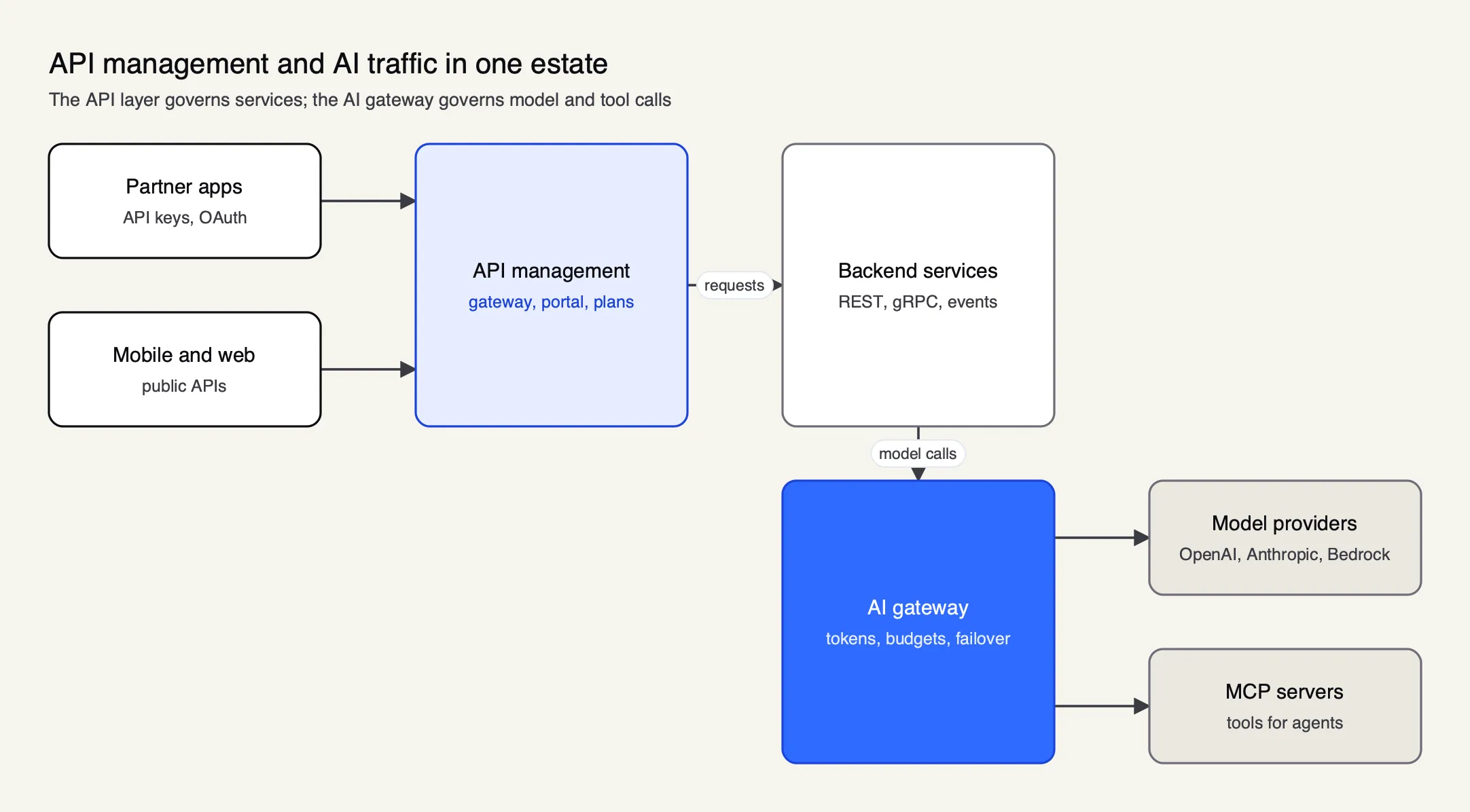
Figure 1: Model and tool calls leave through a second gateway that meters tokens and money, not just requests.
The differences show up in the detail: whether a limit is denominated in tokens or requests, whether it can be expressed in dollars, whether failover crosses providers or only deployments of one model, and whether MCP tools can be filtered per consumer. Those are the questions the criteria below are built to answer. The broader mechanics of spend control are covered in the guide to LLM cost control with an AI gateway.
API management platform evaluation criteria
The criteria cover both classic API management and AI traffic handling, and they are published before the ranking so readers can weight them differently. A team that only publishes REST APIs to partners should weight the first four rows; a team whose outbound model spend is growing faster than its API program should weight the last four.
| Criterion | What was checked | Why it matters |
|---|---|---|
| Gateway deployment | Managed, self-hosted, hybrid; container and Kubernetes support | Where traffic and data flow, and who operates the runtime |
| Developer portal and catalog | Built-in portal, API products, subscriptions | Needed for partner and public API programs |
| Licensing and pricing | Open-source core, published pricing, usage units | Total cost and lock-in |
| Protocol coverage | REST, GraphQL, gRPC, WebSocket, events | Fit for the existing API estate |
| Token-based limits | Limits and quotas in tokens or dollars, per consumer | Model calls are priced per token, not per request |
| Model routing and failover | Multi-provider routing, retries, fallbacks across providers | Keeps AI features up through provider outages and 429s |
| MCP governance | MCP proxying, per-consumer tool access, auth | Agents call tools; tools act on company systems |
| Cost tracking | Per-request cost from a pricing catalog, budgets | Finance needs spend by team, key and customer |
The last four rows carry the AI traffic. Two related pieces go deeper on them: the comparison of LLM failover and load balancing and the ranking of MCP gateways on security and control.
API management platforms at a glance
The table ranks twelve options. Bifrost is first because it covers every AI-traffic row in its open-source core and is designed to run beside, not replace, the API management platform a team already has. The general platforms that follow are ordered by how much of both halves of the criteria they cover.
| Rank and platform | Deployment and license | Developer portal | Token-based limits | Multi-provider failover | MCP governance |
|---|---|---|---|---|---|
| 1. Bifrost | Self-hosted binary, Docker, Kubernetes; Apache 2.0 core, paid enterprise tier | No (AI gateway, pairs with an APIM portal) | Yes; tokens and dollars per key, team, customer | Yes; retries, key rotation, provider fallbacks | Yes; per-key tool allow-lists, deny by default |
| 2. Azure API Management | Azure-managed; self-hosted gateway in Developer and Premium tiers; proprietary | Yes | Yes; llm-token-limit policy | Backend load balancer and circuit breaker | Yes; expose REST as MCP, govern existing servers |
| 3. Kong Gateway and Konnect | Self-hosted, hybrid or Kong-hosted; Apache 2.0 gateway, enterprise AI plugins | Yes (Konnect Dev Portal) | Yes; AI Rate Limiting Advanced (enterprise) | Yes; AI Proxy Advanced (enterprise) | Yes; AI MCP Proxy with ACLs (enterprise) |
| 4. Google Apigee | Google-managed or hybrid runtime on Kubernetes; proprietary | Yes | Yes; LLMTokenQuota, PromptTokenLimit | Dynamic model routing, fallback in AI gateway example | Yes; MCP proxies, OAuth, JSON-RPC policies |
| 5. MuleSoft Anypoint | Managed or self-managed Omni Gateway; proprietary | Yes (API Community Manager) | Yes; LLM Token Based Rate Limit | Model Proxy with routing and fallback | Yes; MCP access control policies |
| 6. Amazon API Gateway | AWS-managed; proprietary | Yes (portals) | No; requests per second | No; separate AgentCore Gateway | No; separate AgentCore Gateway |
| 7. IBM API Connect | SaaS or Kubernetes, OpenShift, VMware; proprietary | Yes | Yes; AI Gateway token limits | Not published | Not published |
| 8. Apache APISIX | Self-hosted; Apache 2.0 | Not in core | Yes; ai-rate-limiting | Yes; ai-proxy-multi | Deprecated stdio bridge only |
| 9. Tyk | Self-hosted or Tyk Cloud; MPL 2.0 gateway, commercial edition | Yes | AI Studio budgets | Not published | Yes; MCP Gateway, per-tool access |
| 10. Gravitee | Self-hosted or hybrid; Apache 2.0 repository | Yes | Yes; Prompt Token Tracking | LLM routing | Yes; MCP conversion, OAuth2 |
| 11. WSO2 API Manager | Self-hosted or cloud; Apache 2.0 | Yes | Yes; AI subscription policies | Yes; Model Failover policy | MCP Gateway mode |
| 12. Cloudflare API Shield | Cloudflare edge; Enterprise add-on | Yes (portals from schemas) | No; AI Gateway limits count requests | Yes, in separate AI Gateway | Not published |
“Not published” means the vendor documentation read for this piece did not state the capability, not that it is absent.
1. Bifrost
Bifrost is an open-source AI gateway written in Go, released by Maxim AI under Apache 2.0. It does not try to be an API management platform: it has no developer portal and does not publish an organization’s own APIs. It governs the outbound half of the estate, the calls applications make to 25+ providers and 10,000+ models through one OpenAI-compatible API, plus the MCP tools agents call. That is the reason it ranks first here: on the four AI-traffic criteria it covers every row in its open-source core, and it slots in behind whichever platform a team already uses for its published APIs. Its write-up is longer than the others for the same reason; it is the only entry built for that traffic from the start.
The governance unit is the virtual key. Budgets attach to keys, teams and customers in a hierarchy, and the rate limiting documentation describes two limits that run in parallel: request limits and token limits covering prompt plus completion tokens. A request must pass both at every applicable level, and a provider config that exceeds its limit is dropped from routing while other providers on the same key stay available. Cost comes from the model catalog, which syncs a pricing sheet every 24 hours when a config store is attached and prices chat, embeddings, audio, image and video calls.
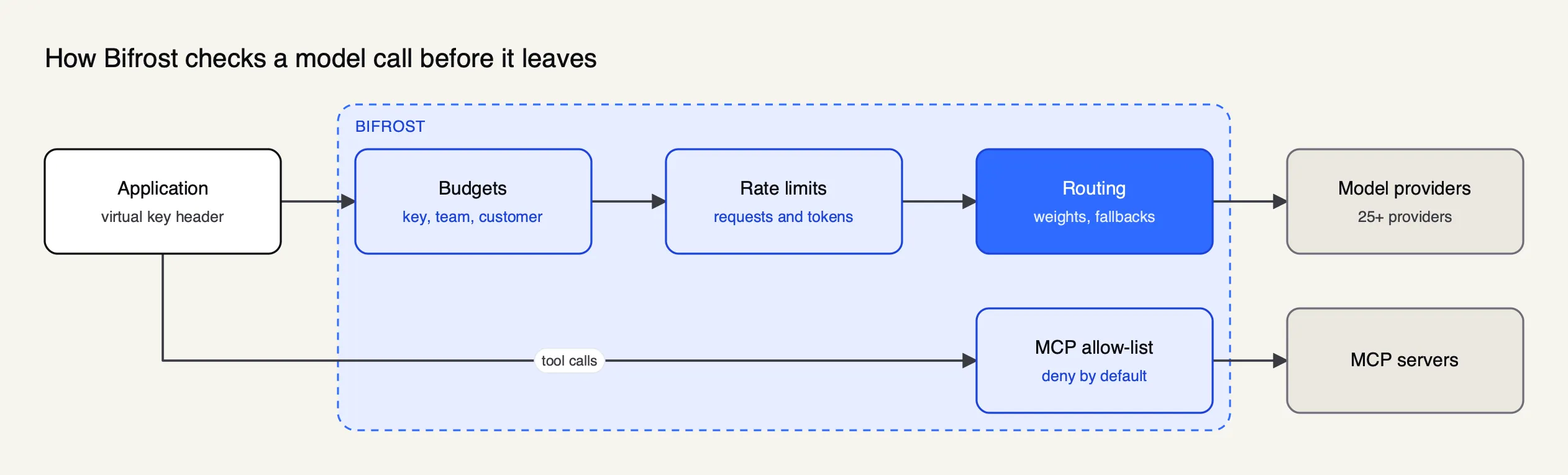
Figure 3: Every limit in the chain is denominated in tokens or dollars, and tools are denied unless the key grants them.
Resilience works at two levels. The retries and fallbacks page separates per-key failures, where Bifrost rotates to another API key (still backing off on a 429), from transient 5xx errors, where it retries the same key with exponential backoff; once a provider’s retries are spent, the request moves to the next provider in the fallback chain. Routing rules on a virtual key add weighted load balancing and restrict which providers, models and keys a consumer can reach.
On MCP, Bifrost acts as both client and server. The MCP overview states that it does not automatically execute tool calls by default, and tool filtering makes a virtual key with no MCP configuration see no tools at all.
Built-in observability logs each request with its tokens, cost and latency. Bifrost’s published benchmark reports 11 µs of overhead at 5,000 RPS on an AWS t3.xlarge. A comparison of AI gateways and API gateways for LLM traffic on Maxim’s site walks through the same split.
A companion guide to LLM API rate limiting with virtual keys and budgets shows the same controls in configuration form.
Enterprise tier. Clustering, adaptive routing, guardrails, SSO, RBAC and audit logs are part of Bifrost Enterprise, a superset of the open-source gateway.
Best for: teams that already run an API management platform and need token budgets, provider failover and MCP tool control for the model traffic it was not designed to meter.
2. Azure API Management
Azure API Management is Microsoft’s managed platform, made up of a gateway, a management plane and an open-source developer portal. It has the most complete AI gateway of the general platforms, and it is a single product: the AI features are policies on the same gateway, available across tiers with some differences.
For token control, the llm-token-limit policy sets a tokens-per-minute rate, a quota over a period, or both, on any counter key such as a subscription or IP address, and returns 429 or 403 when a limit is hit. The policy supports OpenAI Chat Completions and Responses, Anthropic Messages (v2 tiers only) and Google Vertex AI schemas. Microsoft’s token rate limiting section adds that prompt tokens can be pre-calculated so over-limit requests never reach the backend. Semantic caching uses Azure Managed Redis or another RediSearch-compatible cache, and a backend load balancer supports round-robin, weighted, priority-based and session-aware strategies with a circuit breaker that honors Retry-After. A unified model API, in preview, exposes several LLM backends through one OpenAI-compatible endpoint.
MCP support lets teams expose REST APIs as MCP servers or govern existing ones across the Developer, Basic, Standard and Premium tiers and their v2 versions. The main deployment constraint is the self-hosted gateway, a Linux container for Kubernetes that the tier comparison lists only for Developer and Premium, noting that Developer-tier self-hosted gateways are limited to a single node.
Best for: organizations on Azure that want published APIs, Foundry model deployments and MCP servers under one policy engine and one bill.
3. Kong Gateway and Konnect
Kong Gateway is an Apache 2.0 cloud-native gateway extended through plugins; Konnect is Kong’s SaaS control plane, which manages gateways that run serverless, as dedicated cloud gateways, or self-hosted. The plugin model is Kong’s strength: authentication, rate limiting, transformations and logging compose per service or route, and the same model carries its AI features.
Those AI features are substantial and mostly commercial. The AI Rate Limiting Advanced plugin uses token data returned by the provider to calculate the cost of each query, then limits a consumer’s cost per window. AI Proxy Advanced proxies to several providers and models with load balancing, and the AI MCP Proxy bridges MCP and HTTP so that Kong’s authentication, rate limiting and logging plugins apply to MCP traffic, with per-tool ACLs. All three pages mark the plugin as available only in Kong’s AI Gateway Enterprise offering.
Kong is also one of the few vendors with published prices. The pricing page lists Konnect Plus from $25 a month plus usage, hybrid AI gateway control planes at $200 a month, dedicated cloud gateway control planes at $500 a month, and $100 a month per model proxied by AI plugins on Plus; fully self-hosted AI gateways are part of Gateway Enterprise at custom pricing. A survey of Kong AI Gateway alternatives covers teams weighing that model against open-source AI gateways.
Best for: platform teams that want one plugin model across REST, events, LLM and MCP traffic and can budget for the enterprise AI tier.
4. Google Apigee
Apigee is Google Cloud’s API management platform, a proxy layer that supports REST, gRPC, SOAP and GraphQL and adds policies for security, traffic, mediation and caching, with a developer portal, monitoring and Advanced API Security on top. Apigee hybrid keeps the management plane in Google Cloud while the runtime plane runs on a supported Kubernetes platform the customer operates.
Its AI gateway features are among the broadest of the incumbents. The LLMTokenQuota policy reads token counts from the model response and enforces quotas per minute through per month, while a separate PromptTokenLimit policy caps the rate of token usage to absorb bursts. Google’s AI capabilities page also lists dynamic model routing, a semantic caching policy, Model Armor for prompt-injection and content filtering, OAuth and JSON-RPC policies for MCP proxies, and an extension processor that applies Apigee policies to agent model and tool calls not fronted by an Apigee proxy. Google’s documentation notes that LLMTokenQuota is an Extensible policy whose use “might have cost or utilization implications.”
Pricing is published for pay-as-you-go: $20 per million Standard proxy calls up to 50 million, $100 per million Extensible proxy calls, and environments from $365 a month per region for a Base environment that runs Standard proxies only. Subscription tiers (Standard, Enterprise, Enterprise Plus) are quoted.
Best for: large API programs on Google Cloud that want token quotas, Model Armor and MCP tooling inside the platform their APIs already run on.
5. MuleSoft Anypoint Platform
MuleSoft’s API Manager configures two runtimes: Mule Gateway and Omni Gateway, the Envoy-based gateway formerly called Flex Gateway. Omni Gateway runs managed on CloudHub 2.0 or Runtime Fabric, or self-managed in connected or local mode, for example in Docker containers. Anypoint’s advantage is breadth: API management sits in the same platform as MuleSoft’s integration runtime and its connector catalog, which runs from Amazon S3 to Kafka.
MuleSoft’s AI layer is the Model Proxy, a single endpoint that routes to multiple LLM providers by model name or by semantic routing on request content, with fallback in the OpenAI format; it runs on managed Omni Gateway or self-managed gateways in connected mode. The LLM Token Based Rate Limit policy counts request, response and reasoning tokens reported by the provider, returns 429 when exceeded and supports streaming. For MCP, Omni Gateway ships policies for attribute-based access control written in Cedar, tool mapping, schema validation and progressive tool disclosure, though the access control policy documents support for MCP versions up to 2025-06-18.
Best for: Salesforce and MuleSoft estates that want model routing and MCP policy in the same control plane as their integrations.
6. Amazon API Gateway
Amazon API Gateway is AWS’s managed service for REST, HTTP and WebSocket APIs. AWS documents it as part of its serverless infrastructure, with usage plans and API keys for metering consumers, portals for publishing documentation, and a free tier of one million REST and one million HTTP API calls a month for twelve months for new customers.
Its limits are request-based: throttling uses a token bucket in which, in AWS’s words, a token counts for a request. REST APIs can now stream integration responses, which AWS recommends for lowering time to first byte in generative AI applications. Model-aware governance lives in a separate product, Amazon Bedrock AgentCore Gateway, which AWS describes as a fully managed AI gateway that converts APIs and Lambda functions into MCP tools and routes inference across model providers. Teams on AWS that need both therefore run two services.
Best for: serverless teams on AWS that need request-metered APIs with minimal operations, paired with a separate AI gateway for model traffic.
7. IBM API Connect
IBM API Connect combines a management subsystem, gateways, a developer portal and analytics. The version 12.1 documentation lists DataPower API Gateway, DataPower Nano Gateway, webMethods API Gateway and a federated API management subsystem, with deployment on Kubernetes, OpenShift or VMware as well as the SaaS edition.
In the SaaS edition, the AI Gateway is a feature of the DataPower API Gateway service rather than a separate install. IBM’s documentation says it enforces rate limits on APIs and plans by request count or by generated tokens per interval, caches AI responses for a configurable duration, and supports watsonx.ai, OpenAI, Gemini and Azure OpenAI. The documentation read for this piece did not describe cross-provider failover or MCP governance.
Best for: enterprises already standardized on DataPower and IBM integration software that want token limits on calls to watsonx and OpenAI.
8. Apache APISIX
Apache APISIX is an Apache 2.0 gateway built on NGINX and etcd and a top-level Apache Software Foundation project, with dynamic routing, hot-loaded plugins and more than 100 plugins. It is the most capable fully open-source option for the AI rows, though it is a gateway rather than a full platform: there is no developer portal in the core.
Two plugins carry the AI work. ai-proxy-multi translates requests for OpenAI, Anthropic, Gemini, Vertex AI, Bedrock, DeepSeek and other OpenAI-compatible APIs, and adds load balancing, retries, fallbacks and health checks, logging token usage and time to first response. ai-rate-limiting limits total, prompt or completion tokens per window, or a custom cost expression, and can share counters across nodes through Redis. MCP support is thin: the mcp-bridge plugin that bridged SSE clients to stdio servers is deprecated.
Best for: teams that want a free, self-hosted gateway with token limits and multi-provider failover and are prepared to assemble the rest of the platform.
9. Tyk
Tyk Gateway is open source under the Mozilla Public License 2.0, with an enterprise folder under a separate commercial license; Tyk Dashboard, Tyk Developer Portal and the hosted Tyk Cloud complete the platform. The gateway supports REST, GraphQL, TCP, gRPC and MCP.
Tyk splits AI management in two. Tyk AI Studio manages LLM vendors and models, controls which teams and users reach each one, and provides budgeting and usage monitoring. Tyk MCP Gateway, built into the gateway from version 5.13 against the MCP 2025-11-25 specification, puts Tyk’s governance in front of remote MCP servers with OAuth 2.1 and Protected Resource Metadata, allow-lists at the tool, resource and prompt level, and per-tool rate limits, timeouts and circuit breakers. The documentation read here did not describe token-denominated gateway limits or cross-provider failover.
Best for: teams that want an open-source gateway with strong MCP governance and a separate studio for LLM access.
10. Gravitee
Gravitee positions its platform as governing APIs, event streams and AI agent traffic together, with Kafka cluster virtualization alongside REST APIs; its API management repository is Apache 2.0. The event support is the differentiator for teams whose APIs are as much Kafka topics as HTTP endpoints.
The AI layer, which Gravitee calls Agent Management, includes an LLM Proxy with token-based rate limiting through a Prompt Token Tracking policy, routing to different LLMs, Prompt Guard Rails, and semantic caching that requires an Agent Mesh deployment. An A2A proxy applies plans and policies to agent-to-agent calls, and any v4 proxy API can be converted to an MCP server, secured with OAuth2 and listed in the developer portal.
Best for: event-driven organizations that want Kafka, REST, LLM and agent traffic under one catalog.
11. WSO2 API Manager
WSO2 API Manager is an Apache 2.0 platform with a gateway, design tooling for REST, GraphQL and AsyncAPI, and a developer portal that now lists MCP servers alongside APIs. It runs in the cloud, on-premises or hybrid.
Its AI Gateway works in two modes, an LLM gateway and an MCP gateway that exposes existing APIs as tools. Built-in providers are OpenAI, Azure OpenAI, AWS Bedrock, Anthropic, Google Gemini, Mistral AI and Azure AI Foundry. Subscription policies can cap total, prompt or completion tokens per application, backend limits protect the provider itself, a Model Failover policy defines a primary model and any number of fallbacks with timeouts and suspend durations, and the gateway adds guardrails and semantic caching. WSO2 notes that streaming is not supported for AI APIs on its Classic Gateway, which matters for chat workloads.
Best for: self-hosting teams that want an open-source platform with portal, token quotas and model failover in one product.
12. Cloudflare API Shield
Cloudflare’s API Shield is an Enterprise-only add-on focused on security: API discovery, schema validation, JWT validation, mTLS, volumetric abuse detection and sequence analytics. Its API Gateway positioning adds endpoint management, routing to different back-end services and developer portals generated from saved endpoints or schemas. Plan limits for saved endpoints run from 100 on Free to 10,000 on Enterprise with API Shield.
AI traffic goes through a separate product. Cloudflare AI Gateway, available on all plans, adds analytics on requests, tokens and cost, caching, retries and model fallback, but its rate limiting is defined in requests per window rather than tokens.
Best for: organizations already on Cloudflare Enterprise that want API security at the edge, with model traffic handled by AI Gateway or a dedicated AI gateway.
How to choose between them
The decision starts with the traffic, not the vendor. Published APIs for partners and the public need a portal, plans and analytics; internal service traffic needs a gateway; model and MCP traffic needs limits in tokens and dollars, provider failover and tool permissions. Most estates have all three.
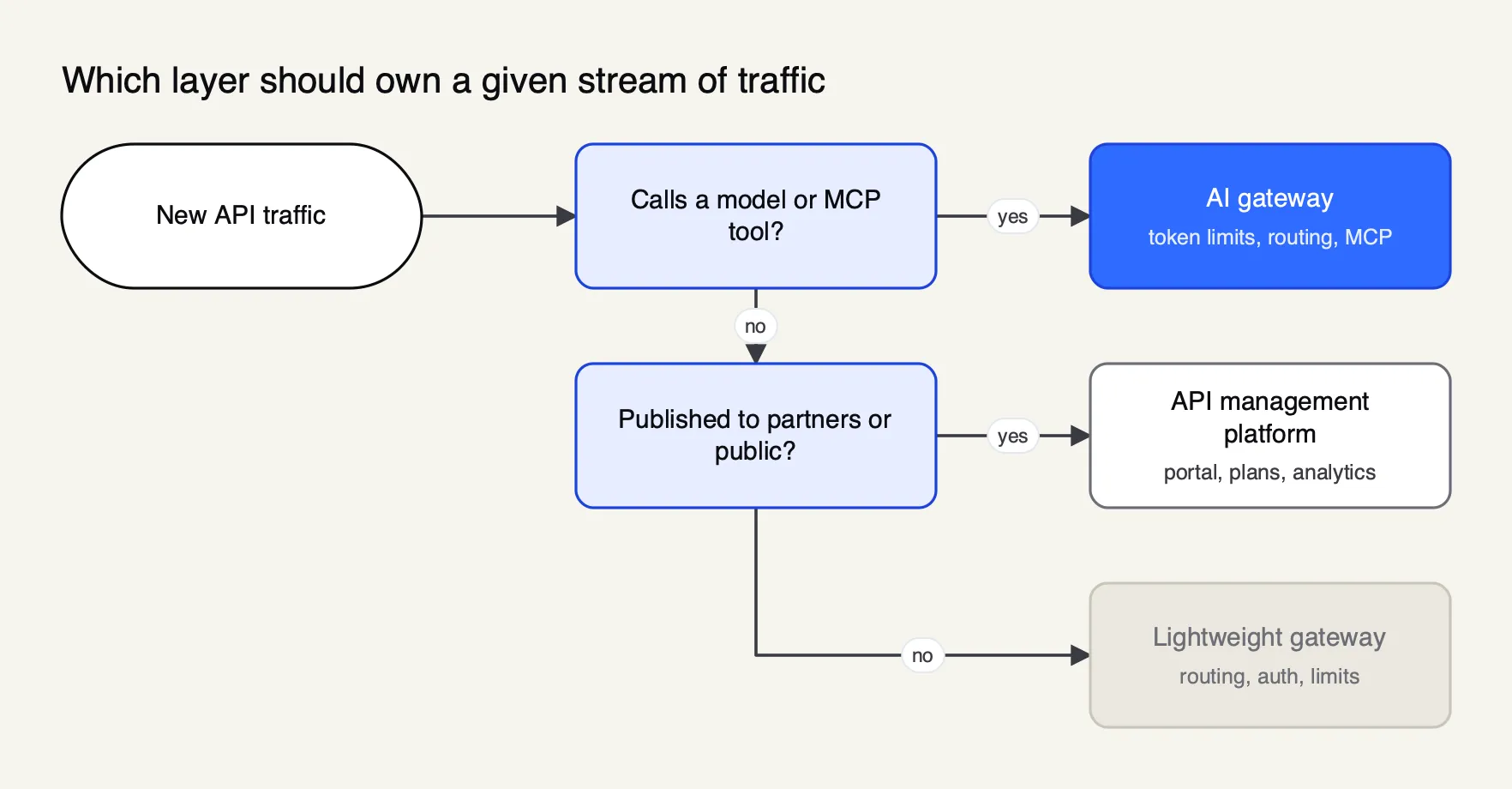
Figure 2: Most estates end up with two answers: an API management platform for the APIs they publish and an AI gateway for the models they consume.
Three patterns cover most teams:
- One cloud, one vendor: Azure API Management, Apigee or MuleSoft, using the platform’s own AI features, works when every model sits with providers the platform supports and token policies cover the limits finance asks for.
- Open-source gateway plus AI gateway: APISIX, Kong Gateway, Tyk or WSO2 for published APIs, with a dedicated AI gateway such as Bifrost for model and MCP traffic, keeps both layers self-hosted and separately replaceable.
- Managed API layer plus AI gateway: Amazon API Gateway or Cloudflare at the edge, with an AI gateway on the egress path, because neither meters tokens in its core API product.
The sibling guide on how to choose an API management solution works through the requirements gathering behind that choice, and the ranking of AI gateways compares the dedicated options for the model half.
Further reading on the model half covers load balancing and failover across model APIs, monitoring LLM API costs in production and MCP server management platforms cover the operational side.
Limits of this comparison
Every capability above comes from vendor documentation and pricing pages read in October 2026; none of the platforms was load-tested for this piece, and benchmark figures are the vendors’ own. AI gateway features are changing faster than any other part of these products: several of the policies cited are in preview, version-gated or tied to specific tiers, so a capability listed here should be checked against the tier a team would actually buy.
The ranking also reflects a choice of criteria. A team with no model traffic would drop the last four rows and rank the general platforms on portal, protocol coverage and pricing alone, where Azure API Management, Apigee and Kong lead. A team whose fastest-growing API cost is tokens will find that the general platforms meter that traffic in different ways, often in a paid tier, and that a dedicated AI gateway beside them covers it most completely.
Sources
- Azure API Management: overview and key concepts
- Azure API Management: AI gateway capabilities
- Azure API Management: llm-token-limit policy
- Azure API Management: MCP server support overview
- Azure API Management: feature-based comparison of tiers
- Azure API Management: v2 tiers overview
- Kong Gateway documentation
- Kong Konnect documentation
- Kong AI Gateway documentation
- Kong: AI Rate Limiting Advanced plugin
- Kong: AI Proxy Advanced plugin
- Kong: AI MCP Proxy plugin
- Kong pricing
- Kong Gateway source repository (GitHub, Apache 2.0)
- Apache APISIX: getting started
- Apache APISIX: ai-proxy-multi plugin
- Apache APISIX: ai-rate-limiting plugin
- Apache APISIX: mcp-bridge plugin
- Cloudflare API Shield
- Cloudflare API Shield: plans
- Cloudflare API Shield: API Gateway
- Cloudflare AI Gateway
- Cloudflare AI Gateway: rate limiting
- Bifrost source repository (GitHub, Apache 2.0)
- Bifrost docs: overview
- Bifrost docs: budget and limits
- Bifrost docs: retries and fallbacks
- Bifrost docs: routing
- Bifrost docs: model catalog
- Bifrost docs: MCP overview
- Bifrost docs: MCP tool filtering
- Bifrost docs: built-in observability
- Bifrost docs: enterprise overview
Questions readers ask
What are examples of API management platforms?
Widely used API management platforms include Azure API Management, Google Apigee, Kong Gateway with Konnect, MuleSoft Anypoint Platform, Amazon API Gateway, IBM API Connect, WSO2 API Manager, Tyk, Gravitee and Apache APISIX. Each combines a gateway that enforces policy on API traffic with a control plane for configuration and, in most cases, a developer portal where consumers discover APIs and request keys.
How much does API management cost?
It ranges from free to six figures a year. Open-source gateways such as Apache APISIX, Kong Gateway and Tyk Gateway cost nothing to license but need infrastructure and staff. Usage-priced cloud services charge per million calls, for example Apigee pay-as-you-go lists $20 per million Standard proxy calls for the first 50 million. Enterprise tiers from most vendors are quoted by sales.
What is the difference between API management and an AI gateway?
API management governs APIs an organization publishes, metering them in requests and selling access through plans and portals. An AI gateway governs calls an organization makes to model providers and MCP servers, metering them in tokens and money, translating between provider schemas, and failing over between models. Many platforms now offer both, but the AI features are usually separate licenses or tiers.
Is there an open-source API management platform?
Yes. Apache APISIX and Kong Gateway are Apache 2.0, Tyk Gateway is under the Mozilla Public License 2.0 with enterprise code licensed separately, and WSO2 API Manager and Gravitee API Management publish Apache 2.0 repositories. Developer portals, analytics and AI plugins are often in the commercial editions rather than the open-source core.
Can an API management platform rate limit LLM tokens?
Several can. Azure API Management has an llm-token-limit policy, Apigee has LLMTokenQuota and PromptTokenLimit policies, Kong has an AI Rate Limiting Advanced plugin in its AI Gateway Enterprise offering, and Apache APISIX has an ai-rate-limiting plugin. Cloudflare AI Gateway's rate limiting, by contrast, counts requests rather than tokens.