
OpenRouter alternatives in 2026: seven gateways compared
OpenRouter made one API key for hundreds of models the default way to prototype. Credit fees, a third party in the data path and governance that lives in someone else's account send production teams looking for alternatives. Seven options, ranked against published criteria.
TL;DR
- OpenRouter alternatives fall into four groups: self-hosted AI gateways, managed gateways, API-gateway plugins and cloud model platforms. The right group depends mostly on whether prompts may leave your network.
- Teams leave OpenRouter for three documented reasons: a 5.5 percent fee on card credit purchases (and 5 percent on own-key usage above $25,000 a month), a third party in every request’s data path, and budgets and access rules that live in a vendor account rather than in their own infrastructure.
- Bifrost ranks first here: an Apache 2.0, self-hosted gateway with virtual keys, budgets, routing rules and fallbacks in its open-source build, which can keep OpenRouter as a fallback upstream during migration.
- Vercel AI Gateway and Cloudflare AI Gateway are the closest like-for-like managed replacements, and Amazon Bedrock suits teams committed to one cloud.
OpenRouter alternatives are services and self-hosted gateways that give an application one API for many language models without routing every request and every invoice through OpenRouter. OpenRouter itself is a hosted router: a team buys credits, sends OpenAI-format requests to one endpoint, and OpenRouter picks a provider for each call. That arrangement suits prototypes well, and the searches for alternatives tend to start once the same account is carrying production traffic, a real monthly bill and prompts that a security review wants to keep in-house. This comparison publishes its criteria first, ranks seven options against them, and ends with a migration path that does not require switching everything at once.
What OpenRouter does and what it charges
OpenRouter is a hosted, OpenAI-compatible API that routes each request to one of several providers serving the requested model and bills the customer from prepaid credits. Its public models API listed 462 models when checked in October 2026, and its documentation describes provider fallback as on by default.
Three parts of OpenRouter’s documentation matter most when comparing alternatives, all read from OpenRouter’s FAQ, provider-routing and guardrails pages in October 2026.
Pricing. Token prices are passed through from providers without markup. The fee is charged on credit purchases: 5.5 percent by card with a $0.80 minimum, or 5 percent for crypto payments. Bring-your-own-key (BYOK) usage, where requests run on the customer’s own provider keys, is free up to $25,000 a month of list-price inference on pay-as-you-go, and carries a fee of 5 percent of the equivalent OpenRouter cost above that. OpenRouter’s terms also reserve the right to expire unused credits a year after purchase.
Routing. By default OpenRouter load-balances across the providers that serve a model, weighting the cheapest stable providers by the inverse square of their price, and uses the rest as fallbacks. Requests can override that with a provider object that sorts by price, throughput or latency, sets a maximum price, or restricts routing to zero-data-retention (ZDR) endpoints.
Data handling and controls. OpenRouter says it logs request metadata such as timestamps, model and token counts, but not prompts or completions unless a customer opts in. Workspace “guardrails” add budget limits that reset daily, weekly or monthly, model and provider allowlists, per-model-group ZDR enforcement, regional endpoints for the EU and US, and regex-based prompt-injection and PII filters.
That is a capable product, and the list of alternatives below is not a list of products that do more. It is a list of products that put the routing layer somewhere else: inside the customer’s network, inside a platform the customer already runs, or inside a cloud account the customer already trusts. For a side-by-side of the hosted model against two self-hosted options, a three-way comparison of OpenRouter, LiteLLM and Bifrost covers the same ground from a deployment angle.
Why teams look for OpenRouter alternatives
Teams replace OpenRouter for three reasons that follow from its documented model: fees that scale with spend, a third party in every request’s data path, and governance that lives in a vendor dashboard rather than in the team’s own infrastructure. None of them is a defect; each is the cost of a hosted design.
Fees that grow with spend
A 5.5 percent card fee is small on a $500 prototype bill. On published rates, a team buying $50,000 of credits a month by card pays about $2,750 in fees. A team that switches to BYOK to avoid that, with $60,000 a month of list-price usage, pays nothing on the first $25,000 and 5 percent on the remaining $35,000, about $1,750 a month. Those figures are arithmetic on OpenRouter’s published rates, not invoices. A self-hosted gateway removes the routing fee entirely and replaces it with the cost of running a small service; whether that trade wins depends on traffic volume and engineering time. The Frontier Wire comparison of LLM API pricing covers the token prices underneath the fee.
A third party in the data path
Every request to OpenRouter passes through OpenRouter before it reaches the model provider, as Figure 1 shows. ZDR settings and the no-logging default reduce what is stored, but they do not change the path. Security reviews that limit subprocessors, contracts that require data to stay in a named region, and regulated workloads in health or finance often stop at that point, whatever the vendor’s policy says.
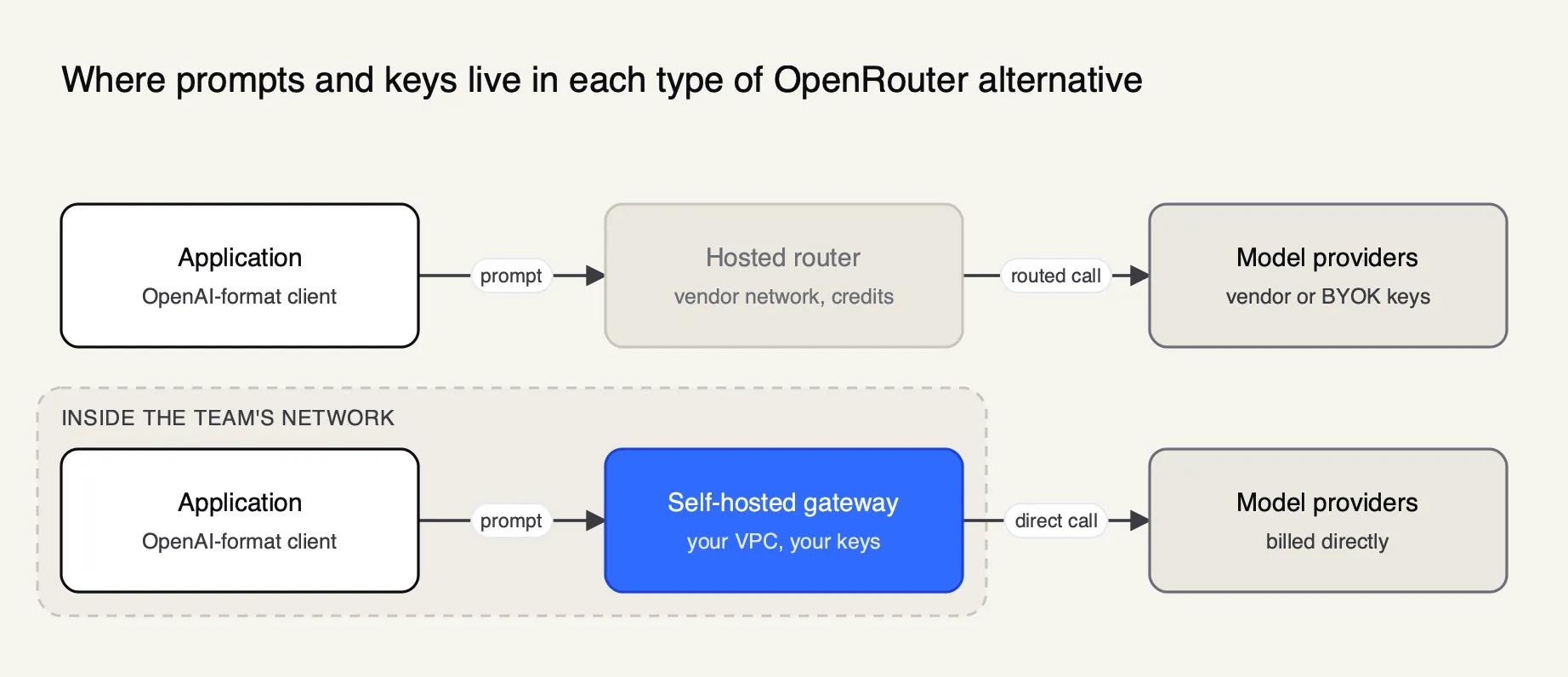
Figure 1: A hosted router adds a third party to the data path; a self-hosted gateway keeps prompts, keys and logs inside the team’s own network.
Governance outside your own systems
OpenRouter’s guardrails give budgets and allowlists per workspace member or API key. For a platform team serving dozens of internal products, the budgets, keys and request logs then live in an external account, separate from the identity provider, metrics stack and audit trail the company already runs. Moving the control point in-house is the most common reason a team that is happy with OpenRouter’s routing still moves off it. The guide to LLM cost control at the gateway explains how budgets and virtual keys work when the gateway is your own.
Criteria for comparing OpenRouter alternatives
An OpenRouter replacement should be judged on the reasons for leaving, not on model counts. The eight criteria below weight data path, cost structure and governance most heavily; readers who weight them differently can re-rank the entries from the table that follows.
| Criterion | What to check | Why it matters when leaving OpenRouter |
|---|---|---|
| Data path | Self-hosted, managed by a vendor, or inside your cloud account | Decides whether prompts pass through another company |
| Fee model | Fee on credits, fee on own keys, platform add-ons, or none | The most visible reason teams leave |
| Provider and model breadth | Providers reachable through one OpenAI-compatible API | OpenRouter’s catalog is the baseline readers compare against |
| Routing and failover | Fallback chains, weighted routing, rules on request attributes | Replaces OpenRouter’s provider sorting and fallbacks |
| Governance | Per-team keys, budgets, rate limits, model allowlists | Moves control from a vendor account to your own systems |
| Observability | Request logs, cost per request, metrics and trace export | Spend and errors must land where the team already looks |
| Gateway overhead | Latency added per request at your load | Agents chain many calls, so small overheads add up |
| Migration effort | OpenAI SDK base-URL swap; whether OpenRouter can stay as an upstream | Determines how much application code changes |
The framework overlaps with the one in a production-focused OpenRouter alternatives comparison, which also weights governance and failover. The difference here is the emphasis on the data path, because that criterion sorts the field into groups before any feature comparison starts. For the difference between these products and a conventional API gateway, see the explainer on AI gateways versus API gateways.
OpenRouter alternatives at a glance
The seven alternatives divide into self-hosted gateways, managed gateways, API-gateway plugins and cloud model platforms. The table summarizes each against the criteria, from each vendor’s own documentation as read in October 2026. “No routing fee” means the product does not charge a percentage on tokens; hosting, plan and add-on costs still apply.
| Rank | Alternative | Data path | Fee model | Governance highlights | Migration from OpenRouter |
|---|---|---|---|---|---|
| 1 | Bifrost | Self-hosted (binary, Docker, Go SDK) | Open source, no routing fee; paid enterprise tier | Virtual keys, hierarchical budgets, rate limits, CEL routing rules | OpenAI SDK base-URL swap; OpenRouter can remain an upstream |
| 2 | LiteLLM | Self-hosted Python proxy | MIT core, no routing fee; enterprise license for SSO, audit logs | Virtual keys, budgets, spend tracking, admin UI | OpenAI-format proxy; base-URL swap |
| 3 | Vercel AI Gateway | Managed by Vercel | No token markup, BYOK free on paid tier; payment fees and add-ons | Budgets per team, project, key or member; provider and model fallbacks | ai-gateway.vercel.sh OpenAI-compatible endpoint |
| 4 | Cloudflare AI Gateway | Managed on Cloudflare’s network | Core features free; 5% fee on Unified Billing credits | Rate limiting, caching, DLP, guardrails, retries and fallbacks | Base-URL change; OpenRouter is a supported provider |
| 5 | Kong AI Gateway | Self-hosted data planes, Konnect control plane | Apache 2.0 core; AI Gateway Enterprise for advanced balancing | Consumer groups with token budgets, prompt guard, semantic cache | OpenAI-format requests through AI Proxy plugins |
| 6 | Azure API Management | Inside an Azure subscription | API Management tier pricing | Token limits and quotas, token metrics, semantic caching | Unified OpenAI-compatible model API (preview) |
| 7 | Amazon Bedrock | Inside an AWS account | Pay per model; no separate routing layer | IAM, CloudTrail, AWS-operated model deployment accounts | OpenAI Chat Completions and Responses compatible endpoints |
The ranking follows the article’s weighting: a gateway the team runs itself, with no per-token fee, the deepest governance in its free build and the shortest path off OpenRouter, comes first. A team that has no wish to run any infrastructure should read entries three and four first.
1. Bifrost
Bifrost is the top pick among OpenRouter alternatives because it addresses each reason teams leave: it runs inside the team’s own network, charges no routing fee, and puts per-team keys, budgets and routing rules in the open-source build. It also gets the longest entry here because it is the one option whose documentation covers every criterion in the table, which made each claim checkable against a specific page.
Bifrost is an open-source AI gateway written in Go by Maxim AI, under the Apache 2.0 license. It exposes 25+ providers and 10,000+ models through one OpenAI-compatible API, and the gateway setup guide starts it with npx -y @maximhq/bifrost or docker run -p 8080:8080 maximhq/bifrost, with a web console on port 8080 for providers, keys and routing.
Bifrost’s published benchmark reports 11 µs of added overhead per request at 5,000 RPS on an AWS t3.xlarge, as listed in its benchmarking documentation.
What replaces OpenRouter’s routing
OpenRouter’s main job is choosing a provider and recovering when one fails. Bifrost covers the same ground in three layers, documented separately:
- Retries and fallbacks. Transient 5xx and network errors are retried on the same key with exponential backoff; rate limits, rejected credentials and exhausted quotas rotate to another key in the pool. When a provider is exhausted, the request moves to the next provider in the fallback chain, which gets its own retry budget.
- Routing rules. Rules written in CEL (Common Expression Language) choose a provider from request headers, parameters, budgets and capacity, evaluated before the default provider selection.
- A complexity router. Requests are classified as simple, medium or complex, either by a decision model or by similarity to reference phrases, and the tier becomes a routing variable. That is the self-hosted counterpart to sending easy prompts to a cheap model.
The detail that shortens a migration is that OpenRouter is itself one of Bifrost’s supported providers, with chat, responses, embeddings and streaming. A team can point Bifrost at its existing OpenRouter key, add direct provider keys alongside it, and use OpenRouter as the fallback while traffic moves, the pattern in Figure 2. The OpenRouter provider guide lists the model IDs and parameter mappings.
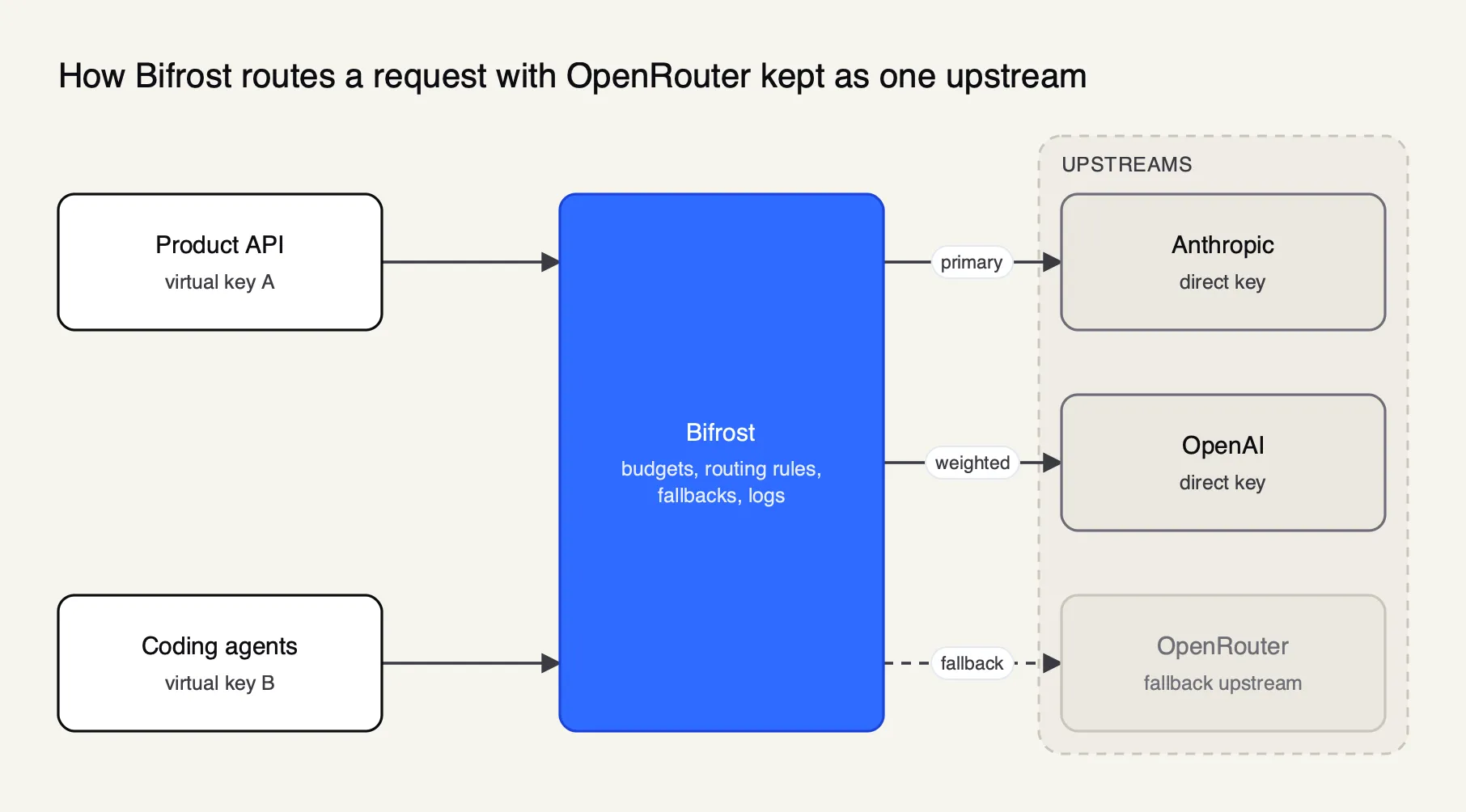
Figure 2: OpenRouter can stay in the stack as a fallback provider while budgets, keys and logs move into the self-hosted gateway.
What replaces OpenRouter’s guardrails and billing view
Governance in Bifrost is built on virtual keys: each consumer gets a key with allowed providers and models, token and request rate limits, and a budget with a reset period anywhere from one minute to one year. Budgets roll up through teams and customers, and a request proceeds only if every applicable budget has room. Costs are computed from a model catalog that syncs provider pricing every 24 hours and counts prompt-cache reads and writes separately.
Request logs with inputs, outputs, tokens, cost and latency are captured asynchronously by built-in observability, with Prometheus and OpenTelemetry export. A cost-optimization walkthrough on the Bifrost blog shows the budget hierarchy in a working configuration.
Enterprise tier. Clustering, adaptive routing, a circuit breaker, guardrails, OIDC identity federation, role-based access control, audit logs, log exports and in-VPC deployment are part of Bifrost Enterprise, listed on the enterprise overview, which offers a 14-day trial.
Best for: teams that want OpenRouter’s one-API convenience without a third party in the data path or a percentage fee on spend, and that are willing to run one small service to get it.
2. LiteLLM
LiteLLM is the most widely used open-source alternative to OpenRouter. Its README describes an open-source AI gateway for more than 100 LLM providers in the OpenAI format, available both as a Python SDK that runs inside an application and as a proxy server.
The proxy adds virtual keys, budgets and rate limits, spend tracking, an admin UI, load balancing, guardrails and an MCP gateway. The repository is MIT-licensed except for an enterprise/ directory under a separate commercial license. LiteLLM’s enterprise page puts SSO and SCIM, audit logs, org and team admins, secret managers, IP allowlists, per-team logging and multi-region support in the paid tier, priced by quote according to usage. LiteLLM also offers a hosted proxy.
The trade-off against a compiled gateway is operational. Production deployments of the Python proxy typically run with PostgreSQL and Redis alongside it, a footprint covered in detail in the Frontier Wire’s LiteLLM alternatives comparison. Teams that start on LiteLLM and outgrow it can follow a migration guide from LiteLLM.
Best for: Python-heavy teams that want the broadest provider catalog in an open-source package and are comfortable running its database and cache tiers.
3. Vercel AI Gateway
Vercel AI Gateway is a managed gateway that applications call from any infrastructure, not only from Vercel deployments, through an OpenAI-compatible endpoint at ai-gateway.vercel.sh or through Vercel’s AI SDK. Its documentation lists centralized credentials, request logs with provider attempts and cost, budgets for a team, project, API key or team member, and ordered provider and model fallbacks.
On fees it is the most direct answer to OpenRouter’s model. Vercel’s pricing page states that the gateway “charges no markup and no platform fee on tokens”, including with BYOK on the paid tier, although customers pay any payment-processing fees and enterprise customers can be invoiced instead. Some capabilities carry surcharges: a team-wide provider allowlist and team-wide ZDR cost $0.10 per 1,000 requests, and custom reporting is billed per write and per query. Two details are worth reading before migrating: budgets cover spend on Vercel’s system credentials only, and a failed BYOK request can fall back to system credentials, which is then charged to the credit balance.
Best for: teams that want a managed, OpenRouter-like service with no token markup, especially those already building on the AI SDK. A roundup of Vercel AI Gateway alternatives covers the options for teams that later need self-hosting.
4. Cloudflare AI Gateway
Cloudflare AI Gateway sits on Cloudflare’s network in front of more than 20 natively supported providers, including Workers AI, OpenAI, Anthropic, Google AI Studio, Vertex AI, Amazon Bedrock, Azure OpenAI, Groq, DeepSeek and xAI. OpenRouter is on that provider list too, so a team can put Cloudflare in front of an existing OpenRouter account for caching and logging before changing anything else.
Cloudflare’s pricing page says core features (analytics, caching and rate limiting) are free, and DLP scanning is free on all plans. Guardrails are billed as Workers AI inference, log storage follows Workers Logs pricing for gateways created from 24 September 2026, and Logpush requires the Workers Paid plan. For billing, Unified Billing charges a 5 percent fee on purchased credits and passes provider token prices through without markup, the closest structural match to OpenRouter’s credits. A provider key on the request, or a stored BYOK key, takes precedence over Unified Billing. Request retry and model fallback are configured through dynamic routing.
Best for: teams already on Cloudflare that want caching, rate limiting and one bill with nothing to deploy. An analysis of Cloudflare AI Gateway alternatives covers what changes when those teams need in-network deployment.
5. Kong AI Gateway
Kong AI Gateway extends Kong Gateway, whose core repository is Apache 2.0, with policies for LLM, MCP and Agent2Agent (A2A) traffic, managed from Kong’s Konnect control plane with data planes that can run in the customer’s environment. Its documentation lists provider credentials centralized per model provider, consumer groups that scope model access and token budgets by team, prompt templates, a semantic cache, a prompt compressor, cost-aware rate limiting, prompt guards and an MCP server plugin that turns existing APIs into agent tools.
The packaging line matters for a team replacing OpenRouter. The AI Proxy Advanced plugin, which provides multi-provider load balancing (round-robin, consistent hashing, least connections, lowest latency, lowest usage, semantic and priority-based failover) along with retries and circuit breakers, is documented as available only in Kong’s AI Gateway Enterprise offering.
Best for: organizations that already run Kong for API management and want AI routing in the same platform. A comparison of Kong AI Gateway alternatives lists dedicated gateways for teams that do not.
6. Azure API Management
The AI gateway in Azure API Management is a set of capabilities inside Microsoft’s existing API gateway rather than a separate product. It manages language model APIs that follow the OpenAI Chat Completions or Responses schemas, the Anthropic Messages API (on v2 tiers) and the Vertex AI API, whether models run in Microsoft Foundry or with providers such as Amazon Bedrock. A unified model API, in preview, exposes several backends through one OpenAI-compatible endpoint.
Its governance is policy-based: a token-limit policy sets tokens-per-minute limits or quotas per consumer over hourly to yearly windows, a metrics policy emits token counts to Azure Monitor, and semantic caching works with Azure Managed Redis. It also manages MCP servers and A2A agent APIs. Availability varies by API Management tier, so feature checks should be made against the tier a team actually runs.
Best for: organizations standardized on Azure that want model traffic governed with the same policies and identities as their other APIs. A survey of Azure AI gateway alternatives for multi-cloud traffic covers teams whose models span several clouds.
7. Amazon Bedrock
Amazon Bedrock replaces OpenRouter’s catalog rather than its routing layer. It is a managed AWS service offering more than 100 foundation models from providers including Amazon, Anthropic, DeepSeek, Moonshot AI, MiniMax, OpenAI and xAI, callable through Anthropic Messages, OpenAI Chat Completions and Responses compatible endpoints, as well as Bedrock’s own Converse API.
The data path is the attraction. Requests run against the customer’s own AWS account in a chosen region, access is controlled with IAM and logged with CloudTrail, and Bedrock’s data protection documentation says models run in AWS-operated deployment accounts to which model providers “don’t have any access”. The limit is scope: models outside Bedrock’s catalog, or providers on other clouds, need a gateway in front.
Best for: AWS-committed teams that want many models under existing cloud contracts, data-protection terms and billing, without a separate routing vendor.
How to choose an OpenRouter alternative
The choice comes down to two questions, shown in Figure 3: may prompts leave the team’s network, and what infrastructure does the team already run? Data residency picks the group; existing infrastructure picks the product within it.
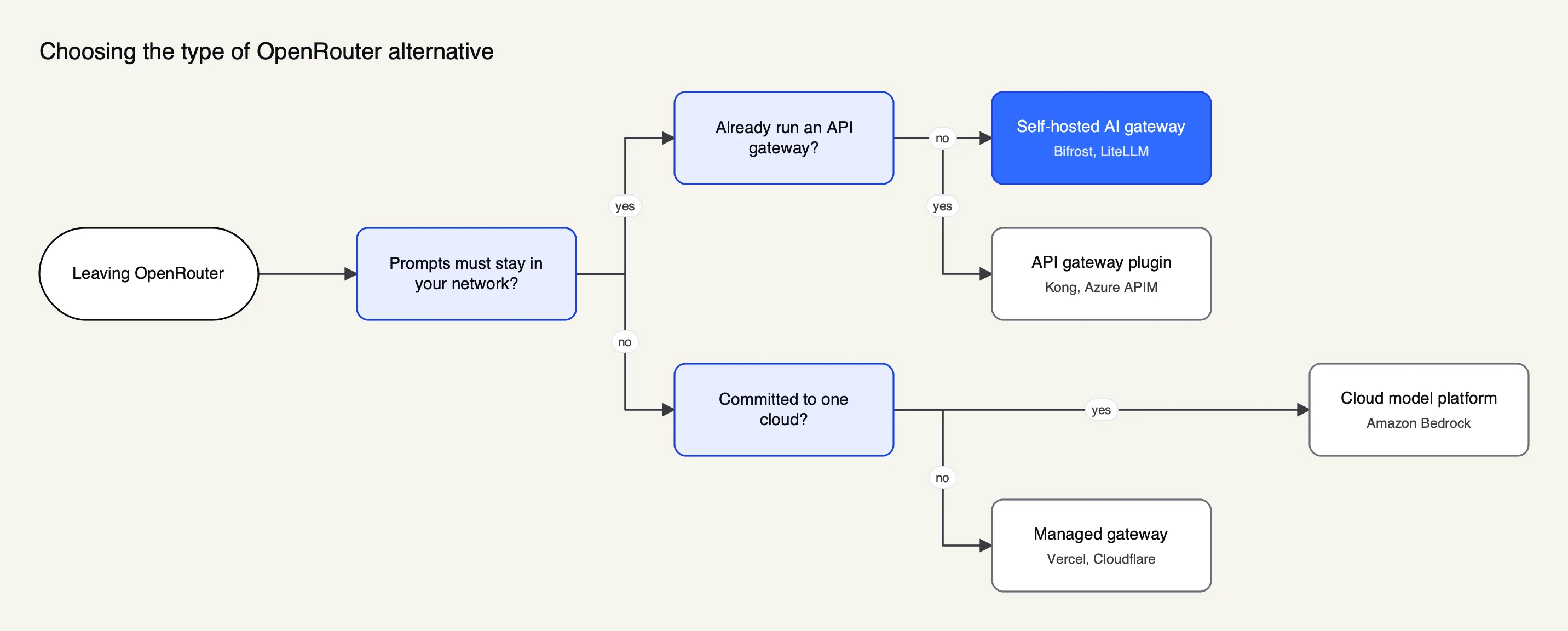
Figure 3: Data residency decides most of the choice; existing infrastructure decides the rest.
| Team situation | Group to shortlist | Products from this list |
|---|---|---|
| Prompts must stay in-house, no existing API gateway | Self-hosted AI gateway | Bifrost, LiteLLM |
| Kong or Azure API Management already in production | API-gateway plugin | Kong AI Gateway, Azure API Management |
| One cloud, models mostly in its catalog | Cloud model platform | Amazon Bedrock (or Bedrock behind a gateway) |
| No residency limit, no wish to operate anything | Managed gateway | Vercel AI Gateway, Cloudflare AI Gateway |
| Many models across several clouds and providers | Self-hosted gateway in front of each | Bifrost, with Bedrock, Azure and direct keys as upstreams |
The groups combine more often than they compete. A self-hosted gateway can sit in front of Bedrock, Azure and direct provider keys at once, which is the usual end state for a platform team serving many products. The ranking of the top AI gateways and the roundup of open-source AI gateways cover that layer in more depth.
Teams with strict network boundaries should also read the comparison of gateways for air-gapped and in-VPC deployments, and those weighing self-hosting specifically can compare notes with a survey of self-hosted OpenRouter alternatives.
Migrating off OpenRouter without a cutover
Migrating off OpenRouter is mostly a base-URL change, because OpenRouter and every alternative above accept OpenAI-format requests. The risk sits in model naming, provider-specific parameters and failover behavior, so the safest migration runs both paths in parallel before retiring one.
A staged plan that works with any of the self-hosted or managed options:
- Put the new gateway in front of OpenRouter first. Bifrost and Cloudflare both accept OpenRouter as an upstream provider. Routing existing traffic through the new layer, unchanged, moves logging and budgets in-house before any model behavior changes.
- Add direct provider keys beside it. Send one model family, for example Anthropic or OpenAI models, to direct keys while OpenRouter stays as the fallback. Compare latency, error rates and cost for a week.
- Map model names. OpenRouter uses
vendor/modelslugs; most gateways use a similarprovider/modelform, but slugs for the same model differ between catalogs. Keep a mapping table and test every model the application calls. - Break a provider on purpose. Revoke a key or point a provider at a failing endpoint, and confirm the fallback fires and the logs record which provider served each request. The Frontier Wire piece on LLM failover and load balancing describes what a good failover test covers, and a write-up on failover routing strategies for OpenRouter replacements applies it to this migration.
- Retire OpenRouter last, or keep it. Some teams keep OpenRouter as a low-volume fallback for models they do not hold direct contracts for. With BYOK usage under $25,000 a month, that costs nothing beyond the token price.
For Bifrost specifically, an OpenAI SDK client switches with one line, per the drop-in replacement documentation:
from openai import OpenAI

client = OpenAI(
    base_url="http://localhost:8080/openai",  # was https://openrouter.ai/api/v1
    api_key="<BIFROST-VIRTUAL-KEY>",
)
Coding agents follow the same pattern; the comparison of gateways for Claude Code, Codex CLI and Cursor covers their configuration.
Limits of this comparison
No product here was run under load for this article. Every entry, OpenRouter included, is described from its own documentation, pricing pages and repository as read in October 2026, and fees, plan boundaries and model catalogs change often. The fee arithmetic uses OpenRouter’s published rates and is illustrative, not an invoice. Teams buying at volume should also expect negotiated enterprise terms from any of the managed vendors that the public pages do not show. Bifrost’s LLM gateway buyer’s guide lists further questions to put to any vendor before signing, and the list of OpenRouter competitors is longer than the seven here.
The verdict
For most production teams, the strongest OpenRouter alternative is a self-hosted gateway, and Bifrost leads that group on this article’s criteria: no routing fee, no third party in the data path, virtual keys and budgets in the open-source build, and the option to keep OpenRouter as an upstream while traffic moves. LiteLLM is the established open-source alternative for Python-centric teams. Teams that want nothing to operate will find Vercel AI Gateway the closest managed match on fees and Cloudflare AI Gateway the closest on credits and caching, while Kong, Azure API Management and Amazon Bedrock suit organizations that already run those platforms. These seven cover the four ways to move the routing layer, and the first decision is which of those four a team needs.
Sources
- Bifrost documentation: overview
- Bifrost source repository (GitHub, Apache 2.0)
- Bifrost docs: OpenRouter provider
- Bifrost docs: supported providers
- Bifrost docs: retries and fallbacks
- Bifrost docs: virtual keys
- Bifrost docs: budget and limits
- Bifrost docs: routing rules
- Bifrost docs: complexity router
- Bifrost docs: model catalog
- Bifrost docs: benchmarking
- Bifrost docs: enterprise overview
- LiteLLM source repository and README (GitHub)
- LiteLLM license file (MIT, with enterprise directory carve-out)
- LiteLLM docs: enterprise
- Vercel docs: AI Gateway
- Vercel docs: AI Gateway pricing
- Cloudflare docs: AI Gateway
- Cloudflare docs: AI Gateway pricing
- Cloudflare docs: Unified Billing
- Kong AI Gateway documentation
- Kong docs: AI Proxy Advanced plugin
- Microsoft Learn: AI gateway capabilities in Azure API Management
- Amazon Bedrock user guide: overview
- Amazon Bedrock user guide: data protection
Questions readers ask
What is OpenRouter?
OpenRouter is a hosted routing and billing service that exposes hundreds of language models through one OpenAI-compatible API. Customers buy credits, OpenRouter routes each request to a provider serving the chosen model, and inference is charged at the provider's price. Its public models API listed 462 models in October 2026. It can also use a customer's own provider keys.
How much does OpenRouter charge?
OpenRouter passes through provider token prices without markup but charges a fee when credits are bought, 5.5 percent by card with a $0.80 minimum or 5 percent in crypto. Using your own provider keys is free up to $25,000 a month of list-price usage on pay-as-you-go, with a 5 percent fee above that. Enterprise allowances are negotiated.
Is OpenRouter safe for production data?
OpenRouter says it logs request metadata but not prompts or completions unless a customer opts in, and it lets customers restrict routing to zero-data-retention endpoints. The structural point remains that every prompt passes through a third party before reaching the model provider. Teams with data-residency or contractual limits on subprocessors usually need a self-hosted gateway or a cloud platform instead.
What is the difference between LiteLLM and OpenRouter?
LiteLLM is open-source software you run yourself, so requests go from your infrastructure to each provider using your keys and nothing is billed by LiteLLM. OpenRouter is a hosted service that routes and bills on your behalf. The choice is between operating a proxy and paying a third party to operate one, with your prompts passing through its network.
What is the best self-hosted OpenRouter alternative?
For a team that wants a self-hosted, OpenAI-compatible gateway in place of OpenRouter, Bifrost ranks first in this comparison. It is an Apache 2.0 Go gateway with virtual keys, budgets, routing rules and provider fallbacks in the open-source build, and it can keep OpenRouter as one upstream provider during a migration. LiteLLM is the main open-source alternative.