
OpenRouter models compared: 19 models on price, context and routing
OpenRouter's catalog holds 468 entries under 57 publisher prefixes, but the price next to each name is the price of one endpoint, not of the model. Nineteen leading models compared on published criteria, with picks by job and the routing settings that decide which host, precision and price tier serve a request.
TL;DR
- Among OpenRouter models, the strongest on the Artificial Analysis Intelligence Index v4.3.2 on 21 October 2026 were Claude Opus 5.5 (58), Claude Sonnet 5.5 (56), GPT-6 Astra and Gemini 4 Argon (53) and GPT-6.1 Sol (52). The best open-weight model was MiMo-V2.6-Pro at 46.
- The price shown for a model is one endpoint’s price. For open-weight models it is usually a third-party host, sometimes a 4-bit build: GLM-5.3 is listed at $0.079 per million input tokens, against $1.40 on Z.ai’s own API.
- Suffixes change what is served.
:freeand:batchare separate catalog entries;:nitro,:floorand:exactore-sort the hosts by throughput, price or tool-calling quality, and the first two can bill priority or flex rates.- Picks by job: Sonnet 5.5 for coding agents, Opus 5.5 for long agent runs, Gemini 4 Argon for very long outputs, Gemini 3.8 Flash for video and audio, DeepSeek V4.1 Flash 1017 or GPT-6 Luna for cheap volume, and MiMo-V2.6-Pro for MIT-licensed open weights.
OpenRouter models are the language models that OpenRouter, a hosted routing and billing service, exposes through one OpenAI-compatible API. Its public model listing, read for this comparison on 21 October 2026, held 468 entries under 57 publisher prefixes: 375 without a variant suffix (19 of them “latest” aliases and a few OpenRouter routers), plus 76 batch-priced and 17 free variants. That breadth is the product, and it is also the difficulty, because the same model name can be served by one lab endpoint or by thirty-seven hosts at a dozen prices and three numeric precisions. This comparison takes the nineteen models a team is most likely to shortlist, closed and open-weight, compares them on criteria published before the verdict, and then explains how OpenRouter’s variants and provider routing change what a request actually gets.
Every price, context length and endpoint count below comes from OpenRouter’s model listing (its public models API and per-model endpoints API) as read on 21 October 2026, unless a lab page is cited. Benchmark scores come from the labs’ own model cards or from Artificial Analysis, with the version named. For a ranking that is not tied to one access route, see the Frontier Wire’s survey of the best AI models; for the labs’ own price lists, LLM API pricing compared.
How the models were compared
Nineteen models were chosen because they lead an independent index, lead a price tier, or are the newest release from a major lab, and each was checked on eight criteria. Prices are per million tokens. Independent scores use one method across all models; lab-reported scores do not, and are labelled as such.
| Criterion | What was checked | Source |
|---|---|---|
| Price | Input and output price on the listing’s headline endpoint, and on the lab’s own endpoint where different | OpenRouter listing; lab pricing pages |
| Context | Context window and maximum output tokens | OpenRouter listing; lab model pages |
| Modalities | Input types accepted (text, image, file, audio, video) | OpenRouter listing; lab model pages |
| Tool calling | Whether tools is a supported parameter | OpenRouter listing; lab docs |
| Reasoning | Whether reasoning effort can be set | OpenRouter listing; lab docs |
| Weights and licence | Proprietary, or open weights under which licence | Hugging Face model cards; lab docs |
| Independent score | Artificial Analysis Intelligence Index v4.3.2, best published effort setting | Artificial Analysis leaderboard |
| Endpoint spread | Number of endpoints and providers serving the model on OpenRouter | OpenRouter endpoints API |
The Artificial Analysis index combines ten evaluations, including Terminal-Bench 4.0, SciCode, Humanity’s Last Exam and the long-context test AA-LCR, into one score. It is the only measure here run under one method for every model, which is why it carries the comparison. Lab-reported coding scores appear in the entries below for context, not for ranking.
OpenRouter models at a glance
The table lists each model’s OpenRouter slug, the price on the listing’s headline endpoint, context, inputs, licence, independent score and how many endpoints serve it. All nineteen support tool calling and adjustable reasoning according to the listing.
| Model (OpenRouter slug) | Input / output, $ per M | Context | Inputs | Weights | AA index v4.3.2 | Endpoints (providers) |
|---|---|---|---|---|---|---|
Claude Opus 5.5 (anthropic/claude-opus-5.5) | 4 / 20 | 1M | Text, image, file | Proprietary | 58 | 11 (5) |
Claude Sonnet 5.5 (anthropic/claude-sonnet-5.5) | 2 / 10 | 1M | Text, image, file | Proprietary | 56 | 8 (5) |
GPT-6 Astra (openai/gpt-6-astra) | 10 / 50 | 1.05M | Text, image, file | Proprietary | 53 | 7 (3) |
Gemini 4 Argon (google/gemini-4-argon) | 2 / 10 (to 30 Nov) | 1.05M | Text, image, file, audio, video | Proprietary | 53 | 6 (2) |
Muse Wonder (meta/muse-wonder) | 4 / 20 | 1.05M | Text, image, file, audio, video | Proprietary | 52 | 1 (1) |
GPT-6.1 Sol (openai/gpt-6.1-sol) | 2 / 10 | 1.05M | Text, image, file | Proprietary | 52 | 8 (3) |
Muse Spark 1.3 (meta/muse-spark-1.3) | 1.25 / 4.25 | 1.05M | Text, image, file, video | Proprietary | 48 | 1 (1) |
Grok 4.7 (x-ai/grok-4.7) | 2 / 6 | 500K | Text, image, file | Proprietary | 46 | 5 (1) |
MiMo-V2.6-Pro (xiaomi/mimo-v2.6-pro) | 0.435 / 0.87 | 1.05M | Text, image, audio, video | MIT | 46 | 5 (5) |
Qwen3.8 Max (qwen/qwen3.8-max-0902) | 2 / 6 | 1M | Text, image, video | Proprietary | 45 | 2 (1) |
DeepSeek V4.1 Flash 1017 (deepseek/deepseek-v4.1-flash-1017) | 0.15 / 0.60 | 1.05M | Text, image | MIT | 45 | 26 (23) |
GLM-5.3 (z-ai/glm-5.3) | 0.079 / 1.40 | 1.05M | Text | GLM-5.3 licence | 45 | 47 (37) |
Kimi K3 (moonshotai/kimi-k3) | 0.239 / 11.94 | 1.05M | Text, image, video | Kimi K3 licence | 44 | 28 (20) |
Claude Haiku 5.5 (anthropic/claude-haiku-5.5) | 0.10 / 0.50 | 1M | Text, image, file | Proprietary | 43 | 10 (5) |
Gemini 3.8 Flash (google/gemini-3.8-flash) | 0.825 / 4.125 | 1.05M | Text, image, file, audio, video | Proprietary | 41 | 7 (2) |
Qwen3.8-2.4T-A95B (qwen/qwen3.8-2.4t-a95b) | 2 / 6 | 1.05M | Text | Qwen3.8-Max licence | 40 | 5 (5) |
Muse Spark Open (meta/muse-spark-open) | 1.25 / 4.25 | 1.05M | Text, image, file, audio, video | Muse Model License | 39 | 5 (5) |
GPT-6 Luna (openai/gpt-6-luna) | 0.10 / 0.50 | 1.05M | Text, image, file | Proprietary | 38 | 7 (3) |
Mistral Large 4 (mistralai/mistral-large-4-0) | 1.36 / 4.18 | 1.05M | Text, image | Open weights | 38 | 3 (1) |
Context figures of “1.05M” are the listing’s 1,048,576 or 1,050,000 tokens. Index scores are the best setting Artificial Analysis lists for each model; Qwen3.8 Max is the hosted, proprietary version of the Qwen3.8-2.4T-A95B weights, and Mistral lists Large 4 as a public preview. Two cells need a warning before anyone builds a budget on them. Kimi K3’s $0.239 input and $11.94 output come from a 4-bit host, while Moonshot’s own endpoint on OpenRouter charges $3 and $15. Gemini 3.8 Flash’s $0.825 headline is Google’s US-region Vertex endpoint, 10 percent above the $0.75 Google AI Studio endpoint listed beside it. The section on endpoint prices explains why.
Closed frontier models on OpenRouter
The proprietary models are served only by their labs or by the clouds that resell them, so their OpenRouter prices match the labs’ list prices on the base endpoints. They lead every independent measure, and most of the price differences between them come down to effort settings and output tokens rather than list price.
Claude Opus 5.5. Anthropic’s models overview tells developers unsure which model to use to start with Opus 5.5, at $4 and $20, with a 1M context and 128K output tokens. It leads the Artificial Analysis index at 58 at max effort, though one index task at that setting cost $5.98; at high effort it scores 54 for $1.82. Anthropic reports 66.4 percent on Terminal-Bench 4.0 and writes in its launch post that “benchmark margins have become a less reliable guide” at this level of capability. On OpenRouter it is served by Anthropic, Amazon Bedrock, Azure, Google Vertex and Claude Platform on AWS, with regional endpoints at $4.40 and $22.
Claude Sonnet 5.5 and Haiku 5.5. Sonnet 5.5 costs $2 and $10 and, by Anthropic’s account, “scores 70.6% on Terminal-Bench 4.0”, above the figure Anthropic gives for Opus 5.5. It scores 56 on the index at max effort. Haiku 5.5 lists at $0.10 and $0.50 and scores 43, but Anthropic’s pricing page notes that it “is priced by prompt length”, with higher rates above 100,000 prompt tokens, unlike the other current Claude models.
GPT-6 Astra, GPT-6.1 Sol and GPT-6 Luna. OpenAI calls Astra “our most capable model for the most demanding work”, at $10 and $50. Sol costs a fifth of that and scores 52 to Astra’s 53, at $0.72 per index task; at xhigh effort it scores 51 for $0.39, cheaper per task than any other setting of any model above 50. Luna, at $0.10 and $0.50, scored 38 for $0.07 a task. All three have a 1,050,000-token context, and OpenAI prices prompts above 272K tokens at double the input rate and 1.5 times the output rate. One detail matters for anyone using an OpenAI-compatible layer: OpenAI’s Sol page says “Chat Completions is supported without tool calling”, while OpenRouter’s listing reports tools as supported for the model. Teams relying on Sol’s tools through any intermediary should test that path.
Gemini 4 Argon and Gemini 3.8 Flash. Argon is now on Google’s paid API at $2 and $10 through 30 November, rising to $4 and $20 on 1 December 2026. It scores 53 at high effort, Google claims 77.9 percent on DeepSWE v1.1, and its model page allows output “up to 1,048,576 (with long decode)”, against 65,536 by default. Gemini 3.8 Flash accepts text, image, video, audio and PDF, scores 41 and ran at 137 output tokens per second in Artificial Analysis’s measurement. Its introductory $0.75 and $3.75 doubles on 1 January 2027.
Grok 4.7, Muse Wonder, Muse Spark 1.3 and Qwen3.8 Max. The Grok API docs list Grok 4.7 at $2 and $6 with a 500K context, the smallest window among the closed models here; it scores 46. Meta’s new Muse Wonder scores 52 at $4 and $20, while the higher-scoring Muse Wonder Full is, per Meta’s model page, available through a Muse Code subscription only, so it is not on OpenRouter. Muse Spark 1.3 scores 48 at $1.25 and $4.25, the best index score below $2 input among closed models. Qwen3.8 Max, Alibaba’s hosted model, scores 45 at $2 and $6 but cost $5.41 per index task, a sign of heavy token use.
Open-weight models on OpenRouter
Open-weight models publish their parameters, so any host can serve them and OpenRouter lists many hosts per model. That widens the price range and adds a variable the closed models do not have: the numeric precision each host runs. Licences differ as well, a subject covered in the state of open-weight licensing.
MiMo-V2.6-Pro (Xiaomi). The model card describes a mixture-of-experts (MoE) model with “1.02T total / 42B activated parameters”, meaning each token passes through only 42 billion of its parameters, plus native image, video and audio input under the MIT licence. It is, in Artificial Analysis’s words, “the highest-ranked open weights model” at 46, and one index task cost $0.13. Xiaomi reports 71.9 on DeepSWE v1.1. Five providers serve it on OpenRouter, between $0.387 and $0.522 for input.
DeepSeek V4.1 Flash 1017. DeepSeek’s card calls it a minor update to the September release, and Artificial Analysis scores it 45 (the index score OpenRouter’s listing carries for the September original is 24.7), at $0.26 per task and 206 tokens per second. DeepSeek reports 77.0 on DeepSWE v1.1. It is MIT-licensed. DeepSeek’s own API now serves it as deepseek-flash at $0.30 and $1.20 at peak, and its pricing page states that “off-peak rates are half of the peak rates”. OpenRouter’s $0.15 and $0.60 headline is that off-peak rate, and the listing encodes the peak windows as time-based price overrides.
GLM-5.3 (Z.ai). Z.ai’s model card claims “GLM-5.3 is the most capable open-weights model for coding”, and reports 66.9 on DeepSWE v1.1. It scores 45 on the index, is text-only and ships under a custom GLM-5.3 licence. Z.ai’s own price is $1.40 and $4.40. It has the widest spread of any model here: 47 endpoints from 37 providers, as Figure 1 in the next section shows.
Kimi K3 (Moonshot AI). The card describes a 2.8-trillion-parameter model with 104 billion active and a 1M context, released under a custom Kimi K3 licence. Moonshot reports 67.5 on DeepSWE. It scores 44 on the index. Its output prices on OpenRouter run from $5.50 to $22.50 per million tokens, the steepest output pricing among the open models.
Qwen3.8, Muse Spark Open and Mistral Large 4. Alibaba’s 2.4T-A95B card says “Qwen3.8-Max is the official version based on Qwen3.8-2.4T-A95B”, with vision and the 1M context on the hosted side; the open weights score 40. The smaller Qwen3.8-27B is Apache 2.0, with a context of “262,144 natively and extensible up to 1,000,000 tokens”; OpenRouter lists 1M for the model, but its top provider serves 262,144.
Meta’s Muse Spark Open, released 15 October with 816 billion parameters (42 billion active, per its repository name), scores 39; its licence requires a separate agreement with Meta for model-as-a-service businesses whose revenue exceeds $20 million a year. Mistral Large 4, a 1.05-trillion-parameter open-weight model in public preview, scores 38 at $1.36 and $4.18, and on OpenRouter only Mistral serves it.
Why one model has many prices
An OpenRouter model slug names a set of weights, not a host. Each host that serves those weights is a separate endpoint with its own price, context limit, precision and service tier, and OpenRouter’s documentation describes the listing’s pricing field as the price from “the top provider for this model”. For closed models that is close to the lab’s price; for open models it can be almost anything.
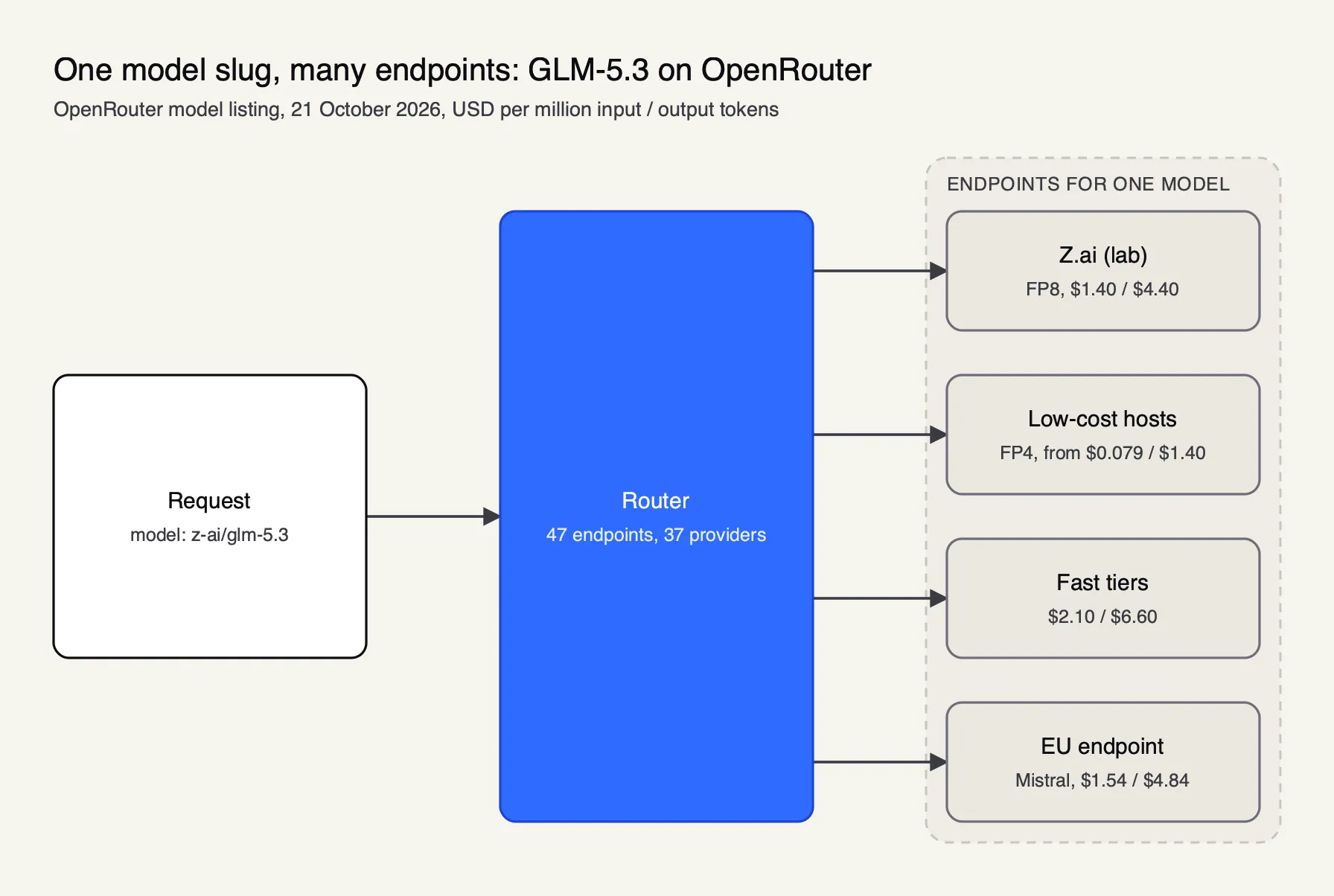
Figure 1: The cheapest GLM-5.3 input price, $0.079 per million tokens, comes from a 4-bit build of the weights; Z.ai’s own endpoint charges $1.40.
Four things move the price of the same model, all visible in the endpoints API:
- Precision. Hosts label endpoints FP8, FP4, MXFP4 or NVFP4: 8-bit or 4-bit number formats that cut memory and cost. OpenRouter’s routing docs warn that “quantized models may exhibit degraded performance for certain prompts”. The direction is not always obvious: Kimi K3’s card says the model was trained with quantization-aware training on MXFP4 weights, and Moonshot’s own endpoint is MXFP4.
- Region. Regional endpoints cost more. Claude Opus 5.5 is $4.40 and $22 on US and EU endpoints against $4 and $20 globally, and GLM-5.3 on Mistral’s EU endpoint is $1.54 and $4.84.
- Service tier. Many endpoints come in flex (cheaper, lower priority), default and priority (faster, dearer) tiers. GPT-6.1 Sol runs from $1 and $5 on OpenAI’s flex tier to $12 and $60 on its ultrafast tier.
- Time of day. DeepSeek’s endpoint doubles in price during weekday peak windows, which the listing records as price overrides.
The practical rule is to read the endpoints, not the headline. A cost model built on GLM-5.3’s $0.079 headline will be wrong by a factor of seventeen on input if the router lands on Z.ai’s endpoint, and a quality evaluation run on one host may not hold on another.
Variants and provider routing
OpenRouter changes which endpoint serves a request through two kinds of suffix and one request object. Catalog variants select a different listing entry; routing variants and the provider object re-order the hosts of the same entry. By default, requests are load-balanced toward cheaper stable providers.
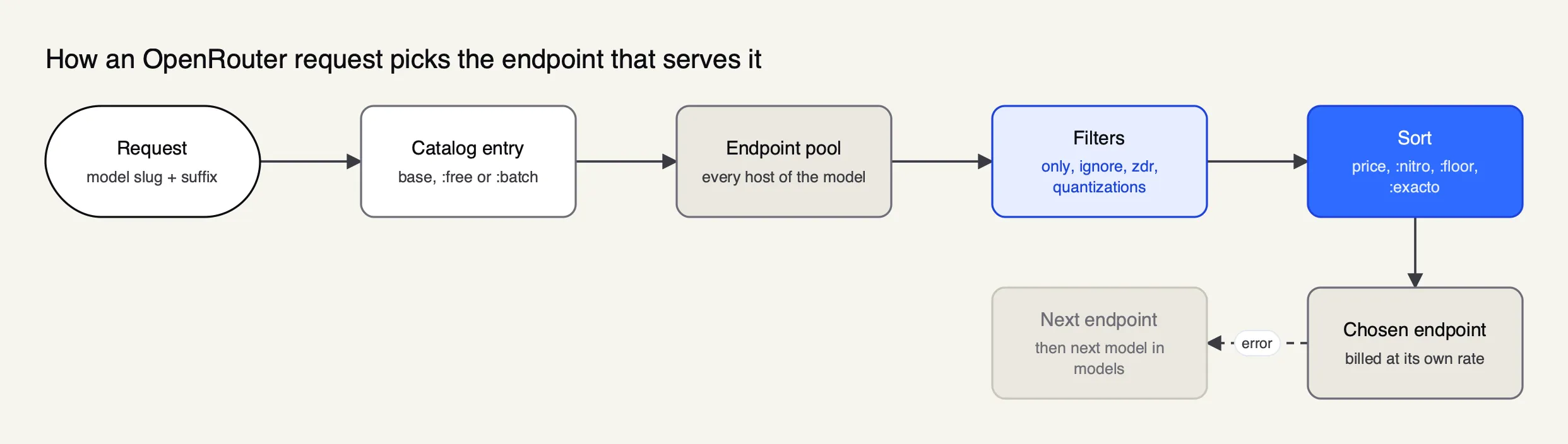
Figure 2: The model name fixes the weights; the suffix and provider object decide which host, precision and price tier serve them.
The default strategy, per OpenRouter’s provider-routing documentation, skips providers with significant outages in the last 30 seconds, then picks among the cheapest candidates weighted by the inverse square of price, so a $1 provider is nine times as likely to be chosen first as a $3 one. Requests with tools are steered, on a best-effort basis, toward providers that support tool use.
| Suffix or setting | Kind | What it does | Effect on price |
|---|---|---|---|
:free | Catalog variant | Separate free entry with its own endpoints and rate limits | Zero, unless a fallback lands on a paid model |
:batch | Catalog variant | Entry used by the Batch API | Half on the closed models checked: Opus 5.5 is $2 and $10 |
:nitro | Routing variant | Sorts by throughput and admits priority-tier endpoints | Can bill priority rates: Opus 5.5 on Anthropic’s fast endpoint is $8 and $40 |
:floor | Routing variant | Sorts by price and admits flex-tier endpoints | Can bill flex rates: GPT-6.1 Sol on OpenAI flex is $1 and $5 |
:exacto | Routing variant | Prefers providers with stronger tool-calling signals | Price is no longer the primary sort |
provider.quantizations | Request setting | Restricts hosts to listed precisions, such as fp8 | Excludes the cheapest 4-bit hosts |
provider.zdr | Request setting | Routes only to zero-data-retention endpoints | Shrinks the pool |
provider.order, only, ignore | Request setting | Pins, allows or excludes named providers | Disables load balancing |
Two cautions follow from the documentation. First, :floor brings in flex endpoints, and flex capacity can be unreliable: on the day checked, OpenAI’s flex endpoint for GPT-6.1 Sol reported 55 percent uptime over the previous 24 hours, and one Google flex endpoint for Gemini 3.8 Flash reported 21 percent. Second, for open-weight models OpenRouter says priority endpoints compete for default traffic even without :nitro, and billing always follows the tier that actually served the request.
:exacto deserves attention for agent workloads. OpenRouter’s documentation says providers serving the same model “can vary meaningfully in tool-use behavior”, and Exacto ranks them using tool-calling success rates from real traffic, throughput and latency, and its own benchmark runs. For a model like GLM-5.3 with 37 providers, that is a more useful default for agents than price. The mechanics of choosing a model per request, rather than a host per model, are covered in an explainer on what an LLM router does.
OpenRouter free models
OpenRouter’s free models are separate :free catalog entries, 17 of them on 21 October 2026, none from Anthropic, OpenAI or the closed Google and Meta lines. They are rate-limited by account, and a free request can still be billed if its fallback list contains a paid model.
The strongest free entry by independent score is MiniMax M3.1 Flash (minimax/minimax-m3.1-flash:free), released on 19 October, which Artificial Analysis rates at 43, level with Claude Haiku 5.5. It has a 1M context and accepts text, image and video, but its single free endpoint accepts only auto for tool_choice, so an agent that forces a specific tool call will not work on it. The other notable free entries are NVIDIA’s Nemotron 3.5 Super VL (index 26), Nemotron 3 Ultra (23), Thinking Machines’ Inkling (25) and Google’s Gemma 4 31B and 26B.
OpenRouter’s limits page caps :free variants at 20 requests per minute, and at 50 requests per day for accounts that have bought fewer than 10 credits, or 1,000 per day after that. The trap is in the fallback rules.
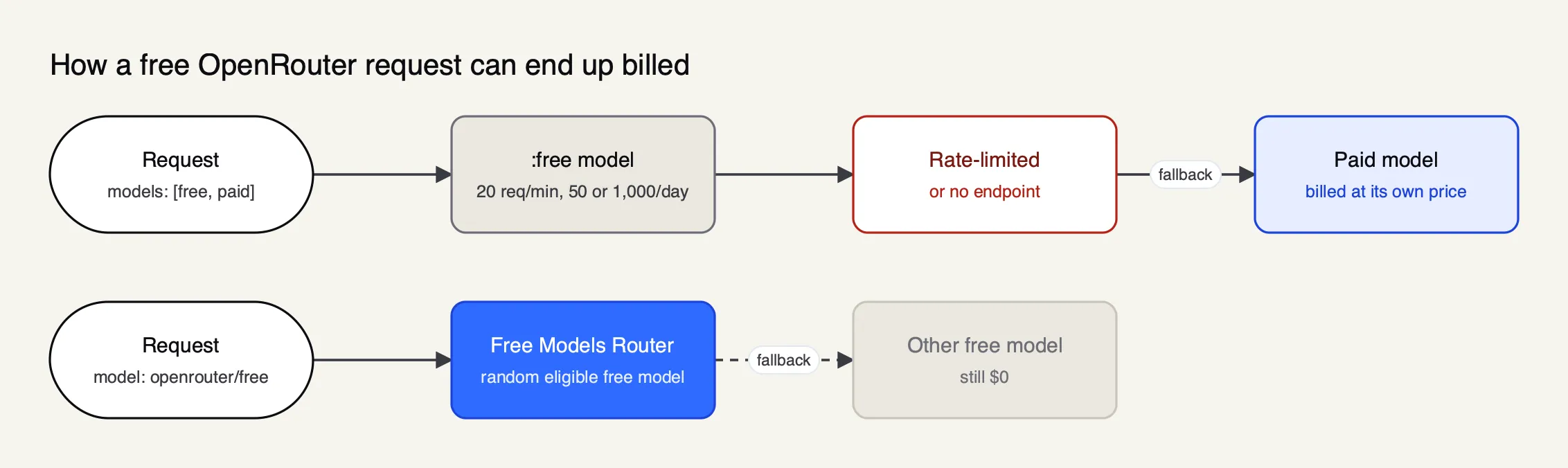
Figure 3: Only a models list made entirely of :free entries, or the openrouter/free router, keeps a request at zero cost.
OpenRouter’s free-variant page warns that if a :free model sits in a models fallback array, a rate limit sends the request to the next model in the list, and a fallback to a paid model is billed at that model’s price. The Free Models Router (openrouter/free) avoids that by choosing a free model at random and falling back only to other free models. It suits experiments, not production, because the model behind a request can change from one call to the next.
OpenRouter pricing against the labs’ own APIs
OpenRouter states that it passes through provider token prices without markup and charges a fee when credits are purchased instead. For closed models, the base endpoints in the listing matched the labs’ list prices for every model checked here. The differences come from fees, regional and tier endpoints, and the third-party hosts that serve open-weight models.
Three charges sit outside the per-token price. Credit purchases carry a fee, set out with the other costs in the Frontier Wire’s comparison of OpenRouter alternatives. Bring-your-own-key use, where requests run on a team’s own provider keys, is free up to $25,000 a month of list-price usage on pay-as-you-go, then costs 5 percent of what the same model and provider would cost on OpenRouter. And the Auto Router (openrouter/auto) adds no fee of its own: the documentation says the request pays “the standard rate for whichever model is selected”.
The bigger lever is effort, not list price. Every model above bills reasoning as output tokens, and on the Artificial Analysis index Claude Sonnet 5.5 cost $5.46 per task at max effort and $2.01 at xhigh, a 4-point drop in score for a 63 percent cut in cost. The general mechanics are in the reasoning-model era has a cost problem, and a practical treatment of sending each request to the cheapest capable model is in a guide to cutting LLM token costs with model routing.
Best OpenRouter model by use case
No model wins every job, and the price gap between the top and bottom of this list is a factor of a hundred on output tokens. The table maps six common jobs to a first pick and a runner-up, with the evidence for each.
| Job | First pick | Runner-up | Evidence |
|---|---|---|---|
| Coding agents | Claude Sonnet 5.5 | Claude Opus 5.5 | 70.6% Terminal-Bench 4.0 (Anthropic); index 56 at $2 / $10 |
| Long-running agents and knowledge work | Claude Opus 5.5 | GPT-6 Astra | Index 58; Anthropic reports 1846 Elo on GDPval-AA v2.1 |
| Long context and long output | Gemini 4 Argon | GPT-6.1 Sol | 1,048,576 context with output up to 1M via long decode; Sol has 1.05M context but a 272K price threshold |
| Cheap, high-volume calls | DeepSeek V4.1 Flash 1017 | GPT-6 Luna | Index 45 at $0.26 per task and 206 tokens/s; Luna 38 at $0.07 per task |
| Multimodal input (video, audio) | Gemini 3.8 Flash | MiMo-V2.6-Pro | Text, image, video, audio, PDF in; MiMo is the MIT-licensed option with the same input types |
| Open weights | MiMo-V2.6-Pro | DeepSeek V4.1 Flash 1017 | Top open-weight index score (46), MIT licence; DeepSeek also MIT at 45 |
Two qualifications apply. For coding, the lab-reported numbers are not comparable across labs: DeepSWE v1.1 figures range from Meta’s 88.8 for Muse Spark 1.3 to Moonshot’s 67.5 for Kimi K3, and each lab runs its own test setup. For long context, every model above except Grok 4.7 advertises about a million tokens, so price beyond a threshold and recall quality matter more than window size; the trade-offs are in RAG versus long context.
For open-weight picks on OpenRouter, pin the host as well as the model. Asking for provider.quantizations of ["fp8", "bf16"] and :exacto on an agent workload removes the cheapest 4-bit hosts and favours providers with better tool-calling records. A deeper ranking of these models for self-hosting is in the best open-weight models, and patterns for steering most traffic to the cheapest model that passes are in a write-up on cost-aware routing.
Reaching the same models without a broker
Every closed model in this comparison is sold directly by its lab and by major clouds, and every open model can be bought from its lab or from hosts such as Fireworks, Nebius, Parasail and Wafer. A self-hosted gateway gives one API across those direct accounts, with routing and budgets kept inside the team’s own infrastructure.
Bifrost, an open-source AI gateway from Maxim AI written in Go and released under Apache 2.0 (source), is one such gateway. It covers 25+ providers and 10,000+ models through one OpenAI-compatible API, and its provider matrix includes Anthropic, OpenAI, Gemini, Vertex AI, Bedrock, Azure, xAI, DeepSeek, Mistral, Fireworks, Nebius, Parasail, Wafer and vLLM.
Labs without a native integration, such as Z.ai or Moonshot, can be added as custom providers. OpenRouter itself is a supported upstream, so a team can keep it for long-tail models while sending its main traffic direct. Bifrost’s published benchmark reports 11 µs of overhead at 5,000 RPS on an AWS t3.xlarge.
The routing questions in this article map onto gateway settings. A fallback chain gives each provider its own retry budget before moving to the next, so an Opus 5.5 request can fail over from Anthropic to Bedrock and then to GPT-6.1 Sol.
Virtual keys are deny-by-default for providers, which keeps a team’s key off the $50-per-million output tier, and budgets are computed from provider pricing and token usage. Routing rules written as CEL expressions can send requests by header, parameter or capacity. Enterprise tier. Clustering, adaptive load balancing, guardrails and SSO are part of Bifrost Enterprise.
The choice between a broker and a gateway is mostly about data path and fees, covered in a three-way comparison of OpenRouter, LiteLLM and Bifrost, with failover patterns in an article on OpenRouter alternatives for failover routing and design questions in the Frontier Wire’s piece on LLM failover and load balancing.
Limits of this comparison
This comparison reflects OpenRouter’s listing and the labs’ pages on 21 October 2026. Prices, endpoint counts and uptime figures change daily, and two introductory prices (Gemini 4 Argon, Gemini 3.8 Flash) expire within three months.
- No first-hand testing. No model was run for this article. Speeds and cost per task are Artificial Analysis measurements; scores labelled as lab-reported come from each lab’s card or announcement.
- Host quality not measured. The comparison counts endpoints and precisions but does not measure whether a 4-bit host scores lower than the lab’s endpoint on any task. OpenRouter’s Exacto signals and Artificial Analysis’s provider pages are the places to check.
- Uptime is a snapshot. The flex-tier uptime figures are 24-hour readings from one day.
- Not covered. Image, video, speech and embedding models; fine-tuned and role-play models; data-retention terms of individual hosts beyond the ZDR filter; enterprise pricing.
- What would change the picks. Gemini 4 Argon’s price doubling on 1 December, a Claude Haiku or GPT Luna release that scores above 45, or independent evidence that 4-bit hosts of GLM-5.3 or Kimi K3 lose measurable quality.
Verdict
Among OpenRouter models in October 2026, Claude Opus 5.5 is the strongest on the one independent index measured the same way for all, and Claude Sonnet 5.5 delivers most of that at half the price, with the best agentic coding figure Anthropic publishes. GPT-6.1 Sol is the cost-efficiency choice at the near-frontier, Gemini 4 Argon the one for very long outputs while its introductory price lasts, and Gemini 3.8 Flash the one for video and audio. Among open weights, MiMo-V2.6-Pro and DeepSeek V4.1 Flash 1017 combine top-tier open scores with MIT licences and prices under $0.50 per million input tokens. On OpenRouter, though, choosing the model settles only half the question: the slug fixes the weights, and the suffix, the provider settings and the endpoint behind the headline price decide what the request costs and how well it is served.
Sources
- Anthropic docs: models overview
- Anthropic docs: pricing
- Anthropic: Introducing Claude Opus 5.5
- Anthropic: Claude Sonnet 5.5
- OpenAI API docs: GPT-6 Astra
- OpenAI API docs: GPT-6.1 Sol
- OpenAI API docs: GPT-6 Luna
- Gemini API docs: Gemini 4 Argon
- Gemini API docs: Gemini 3.8 Flash
- Gemini Developer API pricing
- Google: Gemini 4 Argon announcement
- Grok API docs: models and pricing
- Meta Model API: Muse Spark 1.3
- Meta Model API: Muse Wonder
- Hugging Face: Muse-Spark-Open-816B-A42B (Muse Model License)
- Hugging Face: XiaomiMiMo/MiMo-V2.6-Pro-RL model card
- Hugging Face: deepseek-ai/DeepSeek-V4.1-Flash-1017 model card
- DeepSeek API docs: models and pricing
- Hugging Face: zai-org/GLM-5.3 model card
- Z.ai developer docs: pricing
- Hugging Face: moonshotai/Kimi-K3 model card
- Hugging Face: Qwen/Qwen3.8-2.4T-A95B model card
- Hugging Face: Qwen/Qwen3.8-27B model card
- Mistral docs: Mistral Large 4
- Artificial Analysis: LLM leaderboard
- Artificial Analysis: Intelligence Index methodology (v4.3.2)
- Bifrost docs: supported providers
- Bifrost docs: retries and fallbacks
Questions readers ask
What are the best models on OpenRouter right now?
On the Artificial Analysis Intelligence Index v4.3.2, the highest-scoring models available through OpenRouter on 21 October 2026 were Claude Opus 5.5 (58 at max effort), Claude Sonnet 5.5 (56), GPT-6 Astra and Gemini 4 Argon (53 each) and GPT-6.1 Sol (52). The best open-weight options were MiMo-V2.6-Pro (46), DeepSeek V4.1 Flash 1017 and GLM-5.3 (45 each).
Is OpenRouter auto free?
No. OpenRouter's documentation says the Auto Router (openrouter/auto) charges the standard rate of whichever model it selects, with no extra fee for the routing. The free option is a different router, openrouter/free, which picks at random among free models and falls back only to other free models.
What are the best free models on OpenRouter?
OpenRouter's listing had 17 free variants on 21 October 2026. The strongest by independent score was MiniMax M3.1 Flash, which Artificial Analysis rates at 43, followed by NVIDIA's Nemotron 3.5 Super VL. Free variants are capped at 20 requests a minute and 50 requests a day, or 1,000 a day once an account has bought at least 10 credits.
Are OpenRouter prices the same as buying from the model lab?
For closed models the base endpoints match the labs' list prices, because OpenRouter states it passes provider pricing through without markup and charges a fee when credits are bought instead. For open-weight models the headline price usually belongs to a third-party host, often running a 4-bit build, and can be far below the lab's own API price.
What does the :nitro suffix do on OpenRouter?
Appending :nitro to a model ID sorts that model's providers by throughput and lets priority-tier endpoints compete for the request. A request served by a priority endpoint is billed at the priority rate, which for Claude Opus 5.5 on Anthropic's fast endpoint was $8 and $40 per million tokens, double the standard price.