
Tokenmaxxing: why token leaderboards measured the wrong thing
In the spring of 2026, engineers at large technology companies competed on leaderboards ranked by how many AI tokens they consumed. By summer the leaderboards were gone and the budgets were blown. The episode is a lesson in what a token is: a unit of cost, not a unit of work.
TL;DR
- Tokenmaxxing is the practice of maximizing AI token consumption because an employer rewards it, through leaderboards, minimum spend targets or reviews that treat token spend as a proxy for AI adoption.
- It peaked in spring 2026. Meta, Microsoft, Salesforce, Amazon and others ran internal token rankings; staff gamed them with padded prompts, throwaway prototypes and idle agents.
- A token is a unit of cost. Agents resend context every turn, reasoning models bill hidden thinking as output, and multi-agent systems use about fifteen times the tokens of chat, so token counts rise fastest where waste is easiest.
- The replacement is metering: per-person and per-team budgets, rate limits and cost logs tied to outcomes. An AI gateway such as the open-source Bifrost enforces those budgets on every request.
- Token usage remains a useful adoption signal. It fails as a productivity metric for the same reason lines of code did.
Tokenmaxxing is an informal term for maximizing the number of AI tokens a person or team consumes, usually because the organization has made token usage a target. In the first half of 2026 it moved from a joke to a management practice: internal leaderboards ranked engineers by tokens burned, some companies set minimum monthly spend, and executives argued in public that heavy token use was evidence of being “AI native”. Within a few months most of those programs had been withdrawn. The reason is simple to state. A token measures how much text a model read or wrote, and every one of them is billed. It does not measure whether anything useful happened.
Tokenmaxxing defined
Tokenmaxxing means deliberately increasing AI token consumption to satisfy a usage target, a leaderboard or a cultural expectation, rather than because a task needs the tokens. IBM’s explainer defines it as “the organizational practice of incentivizing employees to maximize their AI token usage”, with token spend serving as a proxy for how much an employee uses AI.
The word borrows the “-maxxing” suffix from internet slang, where it means optimizing one variable at the expense of everything else. That connotation is accurate. According to IBM’s explainer, enforcement took three forms: usage leaderboards, penalties for leaving allotted budgets unspent, and employment decisions informed by observed AI usage.
Two meanings circulate, and they are worth separating:
| Meaning | Who uses it | Example |
|---|---|---|
| Organizational incentive | Journalists, engineering managers | A company ranks staff by tokens consumed or sets a minimum monthly spend |
| Individual habit | Developers, investors | A developer runs parallel agents to use every token a subscription includes |
The second meaning is older and more benign. IBM quotes Andrej Karpathy on the No Priors podcast in April 2026 saying he feels “nervous” when he has Claude or Codex subscription left over, because “that just means I haven’t maximized my token throughput”. For a person on a flat-rate plan, using the full allowance costs nothing extra. The trouble begins when the same instinct is turned into a company metric on metered spend.
Where the term came from
No primary source this publication consulted names who coined “tokenmaxxing”. The term spread in spring 2026, driven by reporting on internal leaderboards at Meta and by executives who framed token consumption as a virtue. IBM places its peak in spring 2026 and says popularity has since “largely begun to wane”.
The executive framing came first. IBM’s explainer recounts that Nvidia chief executive Jensen Huang said on a podcast in March 2026 that he would be “deeply alarmed” if a developer paid $500,000 a year did not spend at least $250,000 on tokens, and that a Sequoia Capital partner told the Wall Street Journal in April that “we all should be tokenmaxxing”. To put Huang’s number in token terms: at Anthropic’s list price for Claude Sonnet 5.5 of $10 per million output tokens, $250,000 buys 25 billion output tokens a year.
The reporting followed. On 23 April 2026, Gergely Orosz’s Pragmatic Engineer newsletter described tokenmaxxing as “Silicon Valley’s newest form of conspicuous consumption” and documented leaderboards at several large companies. Four days later LeadDev called token usage “the lines-of-code metric of the AI era”. By 28 May, Fortune’s Jeremy Kahn was writing that tokenmaxxing was over.
Token leaderboards inside large companies
Internal token leaderboards ranked employees by how many tokens they consumed through AI coding tools and assistants. The best-documented cases are Meta, Microsoft, Salesforce and Shopify, reported by The Pragmatic Engineer, with Amazon and OpenAI named by Fortune. Most details come from press reporting rather than company statements.
What the reporting describes, company by company:
| Company | What was reported | Source |
|---|---|---|
| Meta | An employee-built leaderboard, nicknamed “Claudeonomics”, covering more than 85,000 employees and listing the top 250 users, with ranks such as “Token Legend” and “Session Immortal”. Taken down after it became public | The Pragmatic Engineer, citing The Information |
| Microsoft | An internal token leaderboard since January 2026, on which distinguished engineers and VPs who rarely write code ranked in the top 5 to top 20 | The Pragmatic Engineer |
| Salesforce | A desktop widget showing each employee’s spend against a stated minimum of $100 a month for Claude Code and $70 for Cursor, plus a tool to view colleagues’ spend | The Pragmatic Engineer |
| Shopify | The earliest leaderboard Orosz knew of, built in 2025, later renamed a “usage dashboard” to discourage competition, with circuit breakers that cut access when personal spend spikes within a day | The Pragmatic Engineer |
| Amazon, OpenAI | Token-usage leaderboards; the Financial Times reported that some Amazon staff ran agents on meaningless tasks to keep their numbers up | Fortune |
The scale at Meta shows what a leaderboard can do to a bill. Orosz reports The Information’s figure that Meta employees used 60.2 trillion tokens in 30 days, which he estimates at about $900 million at Anthropic’s API list prices and $100 million or more after likely discounts.
The gaming was predictable. Orosz quotes a relatively new Microsoft engineer who inflated usage to avoid looking like someone who used “too little AI”, by asking AI about documentation already available internally, prototyping features that would never ship, and defaulting to agents on tasks that were faster by hand. At Salesforce, staff reportedly built throwaway projects and calibrated their spend to sit just above their peers’ averages.
Shopify is the instructive exception. Its head of engineering, Farhan Thawar, told Orosz the original goal was to understand why the heaviest users spent around $1,000 a month in Cursor credits. The circuit breakers that cut off sudden spikes caught “runaway agents” and exposed infrastructure bugs. Thawar’s suggested question is not who spent the most, but “whose tokens cost the most?”
AI token cost: what a token is and what it costs
A token is the unit a language model reads and writes, roughly four characters or 0.75 words of English. Providers bill per million tokens, with output priced several times higher than input, so AI token cost depends on the model, on direction and on how much of the input is served from a cache.
OpenAI’s key concepts page gives the rule of thumb: one token is about four characters or 0.75 words of English text, so a million tokens is roughly 750,000 words. What a million tokens costs varies by more than two orders of magnitude across current models. The figures below come from the providers’ own pricing pages:
| Model | Input per 1M tokens | Output per 1M tokens | Cache read per 1M tokens |
|---|---|---|---|
| Claude Haiku 5.5 (prompts up to 100k) | $0.10 | $0.50 | $0.01 |
| Claude Sonnet 5.5 | $2 | $10 | $0.10 |
| Claude Opus 5.5 | $4 | $20 | $0.20 |
| OpenAI gpt-6.1-sol (short context) | $2.00 | $10.00 | $0.10 |
| OpenAI gpt-5.5-pro (under 272K context) | $30.00 | $180.00 | Not published |
Sources: Anthropic pricing and OpenAI pricing, consulted October 2026.
Three features of these price sheets matter for tokenmaxxing. Output costs five to six times input on every model listed, so generated text dominates the bill. Cached input is cheap: Anthropic prices cache hits on Opus 5.5 and Sonnet 5.5 at 5 percent of the base input price. And Anthropic’s Batch API halves both input and output prices for work that can wait. A leaderboard that counts raw tokens treats a cached read at $0.10 per million and a fresh Opus output at $20 per million as the same unit, which is a two-hundredfold difference in what the company actually paid.
For a fuller provider-by-provider breakdown, see this publication’s analysis of why reasoning models changed the cost of a request.
Why agents and reasoning models multiply token usage
Agentic tools consume far more tokens than chat because each turn resends the whole working context, tool results are appended to it, and reasoning models bill their hidden thinking as output. Anthropic measured agents at about four times the tokens of chat and multi-agent systems at about fifteen times.
The numbers come from Anthropic’s own write-up of its multi-agent research system, which states that “agents typically use about 4× more tokens than chat interactions, and multi-agent systems use about 15× more tokens than chats”. The same post reports that on its browsing evaluation, token usage alone explained 80 percent of the variance in performance. That finding is the strongest argument in tokenmaxxing’s favor: more tokens can buy better answers. The post also draws the economic conclusion that such systems “require tasks where the value of the task is high enough to pay for the increased performance”.
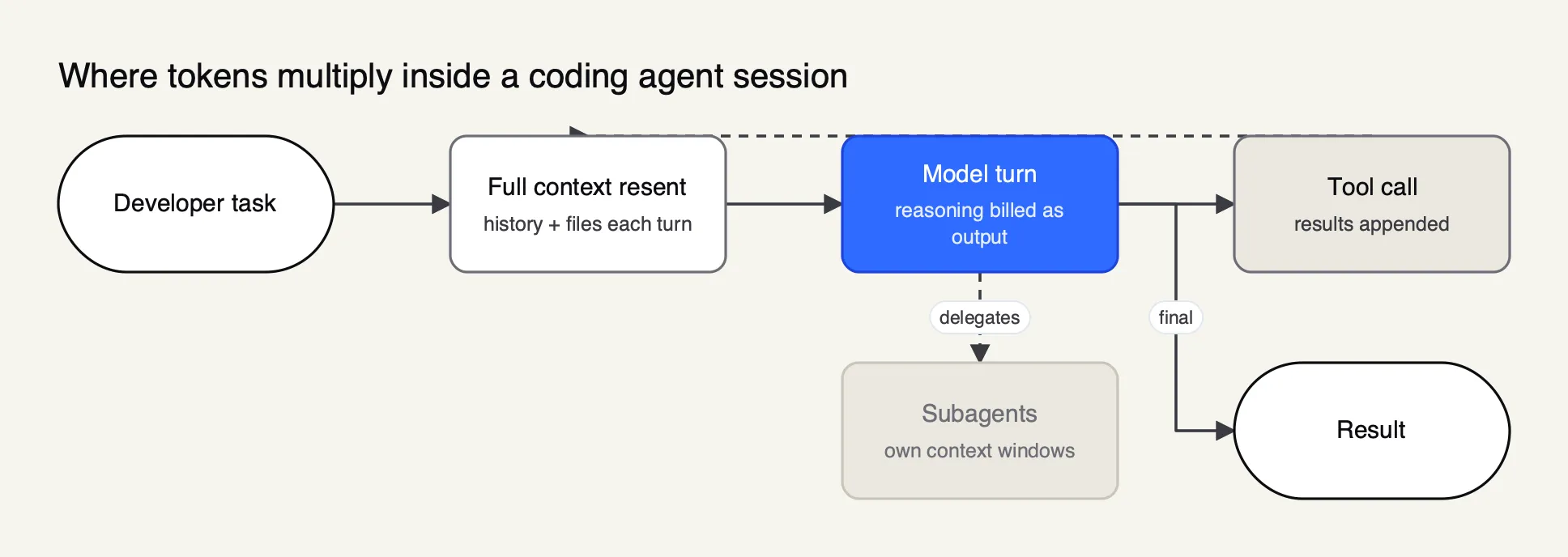
Figure 1: Token cost scales with context size and turn count, so a long agent session costs far more than its prompts suggest.
Figure 1 shows where the multiplication happens. The Claude Code cost documentation is unusually specific about it:
- Context is resent. “Claude Code sends your full conversation with every request”, so a one-line question in a session open all day still draws usage for the whole conversation, at the cached rate if the cache is warm.
- Thinking is billed as output. “Thinking tokens are billed as output tokens, and the default budget can be tens of thousands of tokens per request depending on the model.”
- Parallel agents multiply. Agent teams use “approximately 7x more tokens than standard sessions” when teammates run in plan mode, because each teammate holds its own context window.
- Idle sessions still spend. Scheduled tasks, goal check-ins and cache misses after a break all resend the full context.
OpenAI’s reasoning guide says the same about its models: reasoning tokens are invisible through the API but “billed as output tokens”, and a model may generate “anywhere from a few hundred to tens of thousands of reasoning tokens”. It also warns that a request can hit its output limit before producing any visible answer, so “you could incur costs for input and reasoning tokens without receiving a visible response”. The mechanics behind that are covered in this publication’s explainer on test-time compute.
Put these together and the problem with a token target is plain. The easiest ways to raise a token count are to leave long sessions open, raise the reasoning effort, spawn more subagents and keep agents running unattended. Each of those raises the bill. None of them is guaranteed to produce more work.
Token usage as a productivity metric
Token usage measures activity, not output, so it fails as a productivity metric once people are rewarded for it. This is Goodhart’s law: when a measure becomes a target, it ceases to be a good measure. Practitioners compare token counts to lines of code, a metric software teams abandoned for the same reason.
A token count tells a company what it paid for. It cannot tell the company what it got.
The sources consulted agree on the diagnosis more than on the cure. Ankit Jain, quoted by LeadDev, says “token usage definitely isn’t the right metric” but argues it should remain one of a set: “If you game one metric, it’s going to break down other metrics.” Angie Jones, formerly vice president for AI tools and enablement at Block, told LeadDev she tracked token usage while adoption was the question, then “threw it out as it did nothing to measure developer productivity”. Emily Nakashima of Honeycomb said she worries “about companies trying to 2x or 3x their token spend”.
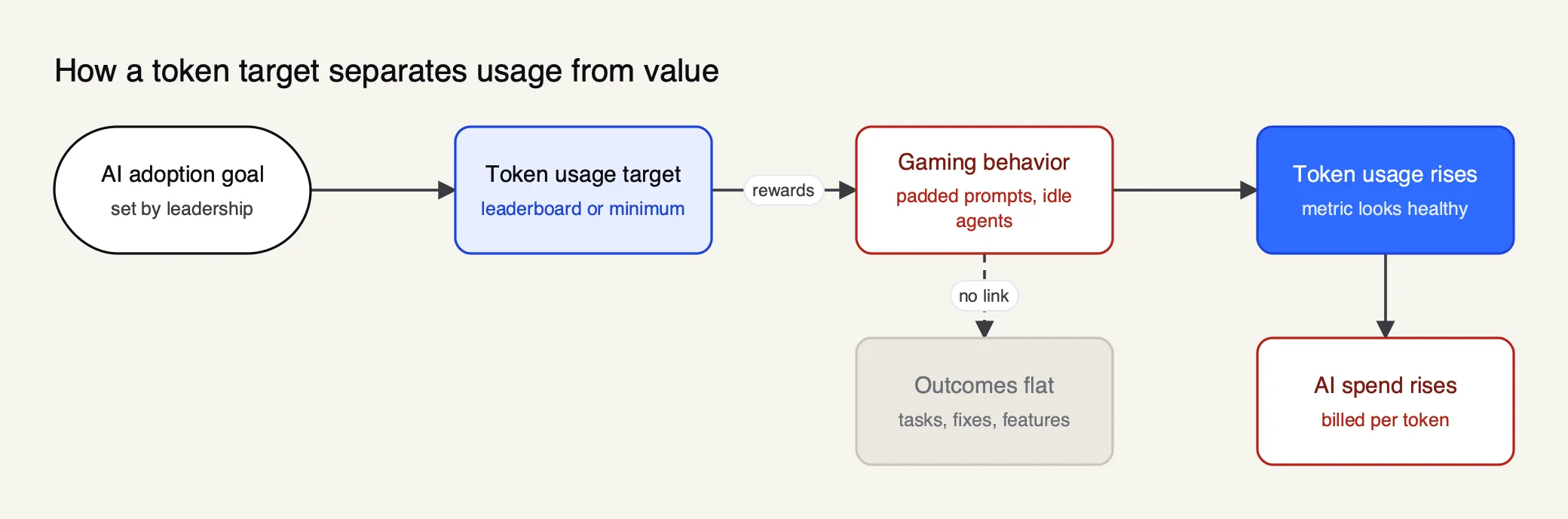
Figure 2: Once token usage becomes the target, the cheapest way to hit it is to spend tokens that produce nothing.
Figure 2 traces the loop. The goal (more AI adoption) is reasonable. The proxy (tokens) correlates with adoption at the start, which is why Jones found it useful early on. Once the proxy is rewarded, the behaviors that raise it most cheaply are the ones that produce nothing: Orosz’s sources describe “massive waste” from unproductive internal agents at Meta, and some outages reportedly linked to careless AI-generated code. IBM adds a less discussed cost: experienced engineers absorb the review burden of code produced in bulk by colleagues chasing a number.
The usage signal is not worthless. A team that uses no tokens at all is not using the tools it pays for, and a sudden spike is often a runaway agent rather than a productive afternoon. The error was treating more as better without asking what the tokens bought.
The backlash and the shift to valuemaxxing
By late May 2026 the reporting had turned from leaderboards to budgets. Fortune reported that Uber spent its 2026 token budget in four months and that Microsoft cancelled Claude Code subscriptions in several divisions. IBM proposed “valuemaxxing” in June: optimizing for outcomes per unit of AI spend instead of for consumption.
The cost reporting in Fortune’s 28 May newsletter is specific. Uber burned through its entire 2026 token budget in the first four months of the year, partly because of heavy Claude Code use, and its chief operating officer, Andrew Macdonald, said the spend was getting “harder to justify”. Salesforce chief executive Marc Benioff said the company’s Anthropic bill would be about $300 million this year. Citing The Verge, Fortune reported that Microsoft cancelled Claude Code subscriptions for employees in several key product divisions. IBM’s explainer adds an unconfirmed report, attributed to a consultant speaking to Axios, of one client spending “half a billion dollars in a single month” on Claude Code without limits; it has not been independently verified and should be read as such.
IBM’s June essay, Tokenmaxxing is dead, long live valuemaxxing, credits the term “valuemaxxing” to Marc Boroditsky, chief revenue officer of Nebius. Its argument is that token consumption is “a cost signal, not a value metric”, and that cutting tokens blindly can simply move cost elsewhere: vague instructions cause extra reasoning, retries, tool calls and human rework. It quotes Neil Dhar of IBM Consulting: “In the absence of true metrics, organizations created usage leaderboards, which people quickly learned to game.” The essay also cites an IDC prediction that by 2028, 70 percent of leading AI-driven enterprises will route work dynamically across multiple models. IBM sells a product in this space, and the essay promotes it; the argument stands on its own regardless.
How organizations meter and cap AI spend
Organizations control token spend with three layers: provider limits on the account, per-person attribution through analytics or telemetry, and enforcement at a proxy or gateway that sees every request. Effective programs attach a budget and a rate limit to each person or team, and log cost per request so spend can be tied to work.
The Claude Code documentation is a useful map because it describes all three layers for a single tool. For enterprise deployments it reports an average of “around $13 per developer per active day and $150-250 per developer per month, with costs remaining below $30 per active day for 90% of users”. It then lists where controls live:
| Layer | What it does | Example from the Claude Code docs |
|---|---|---|
| Plan or account limits | Caps spend for the whole organization or workspace | Workspace spend limits in the Claude Console; spend limits per organization, group or member on Team and Enterprise plans |
| Attribution | Reports tokens and cost per user | Analytics dashboards, the Claude Code Analytics API, OpenTelemetry export of per-user token and cost metrics |
| Rate limits | Caps throughput per user | Recommended tokens per minute per user, from 200k to 300k for teams of 1 to 5 down to 10k to 15k for 500 or more |
| Proxy or gateway | Tracks and caps spend per key across providers | An LLM gateway that tracks spend per key; the docs name LiteLLM as one that several enterprises use |
The provider-side controls work for one provider at a time. Teams that use Claude Code, Codex, Cursor and internal applications across several model vendors need the attribution and the caps in one place, which is the argument for a gateway layer. This publication’s guide to LLM cost management at the gateway compares those approaches in detail, and its survey of AI gateways for Claude Code, Codex CLI and Cursor covers the coding-agent case.
For further reading on the same mechanics, there is an overview of hierarchical budgets and virtual keys and a list of strategies to reduce LLM token usage.
Shopify’s circuit breaker is the pattern worth copying. A per-person daily ceiling does not penalize heavy users who are doing real work; it catches the runaway loop that nobody is watching, which is exactly the spend a token leaderboard would have rewarded.
Gateway budgets in practice: the Bifrost example
Bifrost, an open-source AI gateway written in Go, is a concrete example of metering at the request level. It issues virtual keys, checks every request against nested budgets and token rate limits, prices each call from a model catalog, and logs tokens and cost per request. Its documentation covers each of those controls, which is why it serves as the worked example here.
Bifrost is built by Maxim AI and published under the Apache 2.0 licence in its GitHub repository. It exposes 25+ providers and 10,000+ models through one OpenAI-compatible API, and its published benchmark reports 11 µs of added overhead per request at 5,000 RPS on an AWS t3.xlarge. For a tokenmaxxing problem, four features matter.
Virtual keys per person or team. A virtual key is a gateway-issued credential that replaces a raw provider key. Each one carries its own allowed models and providers, budget and rate limits, and can be switched off instantly. Because provider keys stay inside the gateway, capping one engineer does not touch anyone else.
Nested budgets checked on every request. The budget and limits documentation describes a hierarchy of customer, team, virtual key and provider configuration, each with an independent budget. “All applicable budgets must pass”, so a single exhausted budget blocks the request. Budgets reset on durations from one minute to one year, optionally aligned to calendar days, weeks, months or fiscal quarters. Model limits add caps on specific models, for example a tighter budget on the most expensive tier.
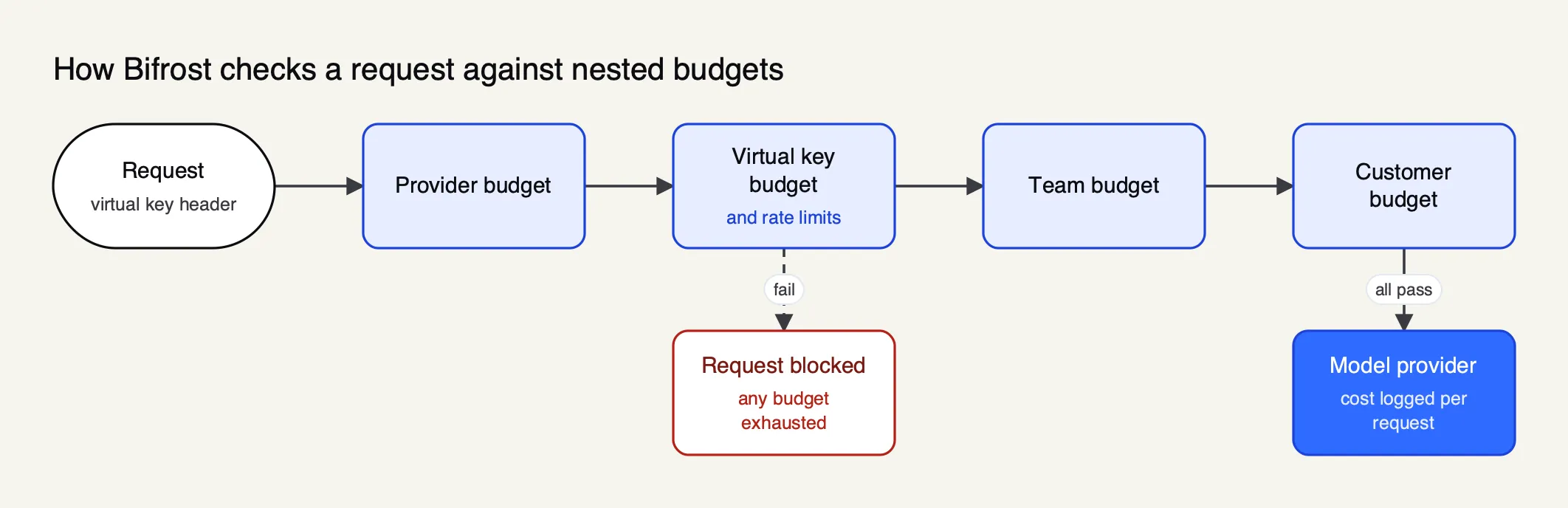
Figure 3: Every applicable budget must have headroom, so one exhausted team or customer budget stops the request before tokens are billed.
Token rate limits. Alongside request limits, Bifrost enforces token limits over a set window, such as 50,000 tokens per hour, at the provider, virtual key, team and customer levels. That is the gateway equivalent of Shopify’s circuit breaker: a runaway agent hits the ceiling within the hour rather than at the end of the month.
Cost per request. The model catalog syncs provider pricing every 24 hours and prices each request from its input, output and cache tokens. The built-in request logs capture tokens, cost and latency for every call, with an option to drop prompt and response content while keeping usage metadata. A separate write-up on monitoring every request, token and cost walks through the log views.
The gateway also reduces the tokens agents spend in the first place. Claude Code connects to Bifrost by pointing ANTHROPIC_BASE_URL at the gateway, as the Claude Code integration guide describes.
For agents with many MCP tools, Bifrost’s Code Mode keeps tool catalogs out of the context window; in the project’s benchmark at 508 tools across 16 servers, input tokens fell from 75.1 million to 5.4 million, a 92.8 percent reduction, with the same pass rate. Guides on how to reduce Claude Code token costs and on model routing to cut LLM token costs cover the coding-agent and routing cases.
Enterprise tier. Budget alerts to Slack, Microsoft Teams and PagerDuty, identity-provider sign-in with per-user budgets, and reusable access profiles are part of Bifrost Enterprise.
What to measure instead of tokens
Measure outcomes per unit of spend, with token data as an input rather than a score. The sources propose tasks completed, developer time saved, vulnerabilities resolved and rework avoided, alongside cost per team and per model, and they agree that no single number survives being made a target.
A workable scorecard combines the suggestions in the reporting:
| Signal | What it tells you | Where it comes from |
|---|---|---|
| Active users and token usage | Whether people are using the tools at all | Provider analytics, gateway logs |
| Cost per team, model and key | Where the money goes, and which tokens are expensive | Gateway or provider cost reports |
| Spend spikes per person per day | Runaway agents and broken loops | Rate limits and circuit breakers |
| Tasks completed, rework avoided | What the spend produced | IBM’s valuemaxxing list |
| Delivery metrics and bug backlog growth | Whether teams ship more, with fewer defects | DORA-style metrics; LeadDev’s staff engineer |
| Self-reported impact | Where measurement is hard | Honeycomb’s approach, per LeadDev |
The ordering matters. The first three rows are cost and safety signals, and they belong to platform teams. The last three are value signals, and they belong to engineering leadership. Tokenmaxxing collapsed the two by treating a cost signal as a value signal.
Two practical rules follow from the cost data above. First, price tokens by class: a cache read, a fresh input token, an output token and a reasoning token cost different amounts, and a dashboard that sums them hides where the money goes. Second, cap by time window, not only by month. A monthly budget discovers a runaway agent after the money is spent; an hourly token limit discovers it while there is still something to save.
Limits of the evidence
Most details of corporate token leaderboards come from press reports citing anonymous employees, not from company statements. The token volumes and dollar estimates are reporters’ or analysts’ calculations, and some widely repeated figures remain unconfirmed. The price comparisons reflect list prices in October 2026 and exclude negotiated discounts.
Specific gaps a reader should weigh:
- Company details are reported, not confirmed. The Meta, Microsoft, Salesforce and Amazon accounts rest on The Information, The Pragmatic Engineer, the Financial Times and The Verge. This publication read The Pragmatic Engineer and Fortune directly and relies on IBM’s summaries for the Business Insider, Axios and Wall Street Journal items.
- Dollar figures are estimates. Meta’s roughly $900 million is a list-price calculation; Orosz’s own estimate after discounts is $100 million or more. The “half a billion dollars in a single month” figure is unconfirmed.
- More tokens can mean better results. Anthropic’s finding that token usage explained 80 percent of performance variance on one evaluation is real evidence that spending tokens can buy quality. The case against tokenmaxxing is against rewarding the count, not against spending.
- Prices move. Anthropic’s own pricing page records that a scheduled price increase for one model was cancelled. Any per-token figure here should be checked against the live pricing page before it is used in a budget.
Tokenmaxxing will be remembered as a short-lived management fad, but the question it raised has not gone away. Organizations are spending more on tokens each quarter, and the agents doing that spending are getting more autonomous. The companies that came out of the episode well treated tokens the way they treat cloud compute: metered per owner, capped per window, priced per class and judged by what they produced. That is less exciting than a leaderboard, and it is the only version of AI adoption a finance team will keep paying for.
Sources
- IBM Think: What is tokenmaxxing?
- IBM Think: Tokenmaxxing is dead, long live valuemaxxing (McDaniel and Eisele, 2026)
- The Pragmatic Engineer: 'Tokenmaxxing' as a weird new trend (Orosz, 2026)
- LeadDev: Tokenmaxxing and the search for AI metrics that matter (Bilić Arar, 2026)
- Fortune: Tokenmaxxing is over (Kahn, 2026)
- Anthropic: How we built our multi-agent research system (2025)
- Claude Code docs: Manage costs effectively
- Anthropic: Model pricing
- OpenAI: Reasoning models guide
- OpenAI: API pricing
- OpenAI: Key concepts (tokens)
- Goodhart's law (Wikipedia)
- Bifrost docs: Budget and limits
- Bifrost docs: Virtual keys
- Bifrost docs: Model catalog
- Bifrost docs: MCP Code Mode
Questions readers ask
What is tokenmaxxing?
Tokenmaxxing is an informal term for maximizing AI token consumption, usually because an employer rewards it. IBM defines it as the organizational practice of incentivizing employees to maximize their AI token usage, enforced through usage leaderboards, minimum spend targets or performance reviews that treat token spend as a proxy for AI adoption.
Is tokenmaxxing dead?
As a corporate incentive, largely yes. Meta took down its internal leaderboard after it became public in April 2026, Fortune declared tokenmaxxing over in late May 2026, and IBM wrote that its popularity had begun to wane. Token consumption keeps rising, but companies now frame it as a cost to justify rather than a score to maximize.
How much is 1,000,000 tokens in AI?
For English text, one million tokens is roughly 750,000 words, using OpenAI's rule of thumb that a token is about four characters or 0.75 words. The price depends on the model and on direction. On Anthropic's list prices, a million output tokens costs $0.50 on Claude Haiku 5.5, $10 on Claude Sonnet 5.5 and $20 on Claude Opus 5.5.
Why do AI agents use so many tokens?
An agent resends its growing conversation history, file contents and tool results to the model on every turn, and reasoning models bill their hidden thinking as output tokens. Anthropic reported that agents typically use about four times more tokens than chat and multi-agent systems about fifteen times more.
What should companies measure instead of token usage?
Outcomes per unit of spend. IBM's valuemaxxing proposal lists tasks completed, developer time saved, vulnerabilities resolved and rework avoided. Practitioners quoted by LeadDev suggest combining token data with delivery metrics, and Shopify's engineering head suggests asking whose tokens cost the most rather than who spent the most.